
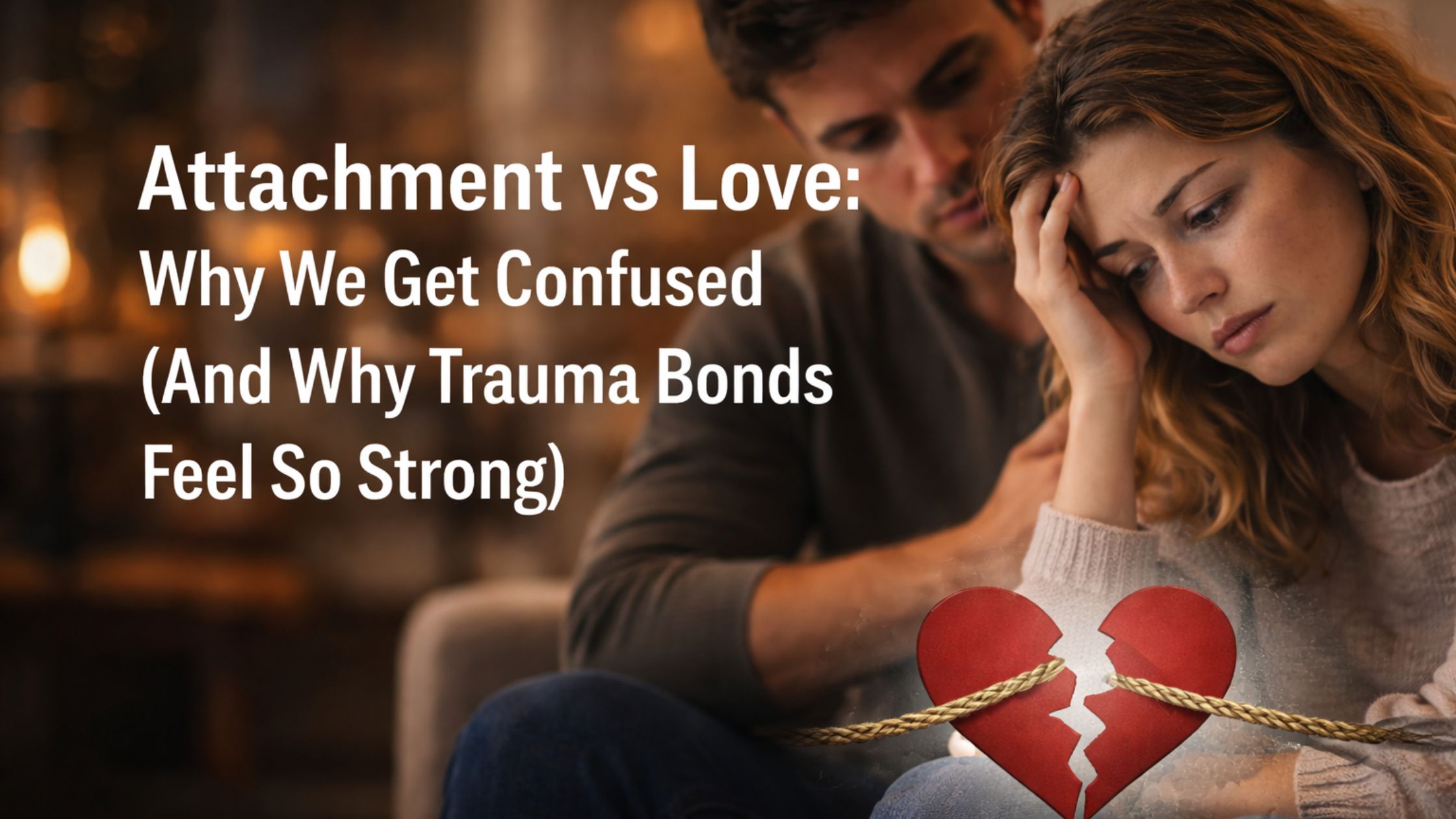
Sometimes a relationship feels intense, hard to leave, and deeply important but also exhausting, confusing, and painful.
You may think, “If this isn’t love, then why does it feel so strong?”
Or, “Why can’t I walk away, even when I know this isn’t good for me?”
This is where attachment and love often get mixed up especially in relationships shaped by emotional highs and lows. This blog explores the difference between the two and why trauma bonds can feel so powerful.
What Love Usually Feels Like
Love tends to feel steady, even if it’s not always easy. There is care, respect, and emotional safety. You can be yourself without constantly second-guessing. Disagreements happen, but they don’t shake your sense of security in the relationship.
Love allows space for individuality, for growth, and for honesty.
It may not always feel intense, but it feels grounding.
What Attachment Can Feel Like

Attachment is about emotional dependence.
It creates a strong pull toward someone, often tied to a need for connection, reassurance, or validation. Attachment isn’t always unhealthy but when it becomes intense and unstable, it can start to feel overwhelming.
You may feel:
- anxious when they pull away
- relieved when they come back
- constantly focused on the relationship
- unsure of where you stand
The connection feels urgent, not calm.
Why the Two Get Confused
Attachment and love can look similar on the surface. Both involve closeness, emotional investment, and connection. But the quality of the experience is different.
Love feels safe and consistent. Unhealthy attachment often feels uncertain and reactive. When intensity is mistaken for depth, attachment can easily be labelled as love.
What a Trauma Bond Is
A trauma bond forms when connection is mixed with inconsistency.
Periods of affection, attention, or closeness are followed by distance, conflict, or emotional pain. This cycle creates a powerful emotional loop.
The brain begins to associate relief and reward with the return of connection after distress. This makes the bond feel stronger over time, even if the relationship is unhealthy.
It’s not just emotional, it's also neurological.
Why Trauma Bonds Feel So Hard to Break
Trauma bonds are not based on simple choice. The push–pull pattern creates dependency. When things feel good, they feel very good. When they don’t, the desire to return to that “good phase” becomes stronger.
This can lead to:
- staying despite repeated hurt
- justifying behaviour that feels wrong
- feeling unable to let go
- believing that things will change
The attachment is reinforced each time the cycle repeats.
The Role of Early Experiences
Often, trauma bonds connect to earlier relational patterns.
If someone grew up with inconsistency where care and distress existed together they may be more familiar with this dynamic. The nervous system recognises it, even if it’s painful.
Familiarity can feel like a connection.
This doesn’t mean someone is choosing unhealthy relationships. It means their system has learned to associate intensity with closeness.
How to Tell the Difference Within Yourself
It can help to gently observe how the relationship feels over time.
Do you feel mostly at ease, or mostly on edge?
Do you feel free to be yourself, or constantly adjusting?
Does the relationship bring clarity, or confusion?
The answers are often already present in your experience.
What Helps Break the Pattern
Breaking a trauma bond is not about willpower alone.
It involves creating distance from the cycle, understanding the emotional pull, and slowly building a sense of safety outside the relationship. This can take time, support, and patience.
The focus shifts from “Why can’t I leave?” to “What am I needing, and how can I meet that safely?”
When to Seek Support
If a relationship feels intense but draining, or if leaving feels impossible despite knowing it may not be healthy, support can help.
A safe, neutral space allows you to understand the attachment without judgment and begin untangling it at your own pace.
Conclusion
Love and attachment can feel similar, but they are not the same.
Love creates safety and space. Trauma-driven attachment often creates urgency and confusion. Understanding this difference is not about blaming yourself, it's about recognising patterns that were learned, not chosen.
If you find yourself stuck in a relationship that feels hard to understand or harder to leave, SoulNirvana offers a supportive space through its Psychological Counselling services. If it feels right, you can book a session now and begin making sense of your experience with clarity and care.
FAQs
Q1. Can attachment exist in healthy relationships?
Yes. Attachment is natural, but it becomes unhealthy when it creates dependency and instability.
Q2. Why do trauma bonds feel like love?
Because intensity and emotional highs can mimic closeness and connection.
Q3. Is it possible to break a trauma bond?
Yes, with awareness, support, and time.
Q4. Does this mean something is wrong with me?
No. These patterns often come from past experiences, not personal failure.
References
Carnes, P. The Betrayal Bond: Breaking Free of Exploitive Relationships.
https://www.goodreads.com/book/show/141678.The_Betrayal_Bond
National Institute of Mental Health. Trauma and emotional patterns.
Van der Kolk, B. A. The Body Keeps the Score.
https://www.besselvanderkolk.com/resources/the-body-keeps-the-score