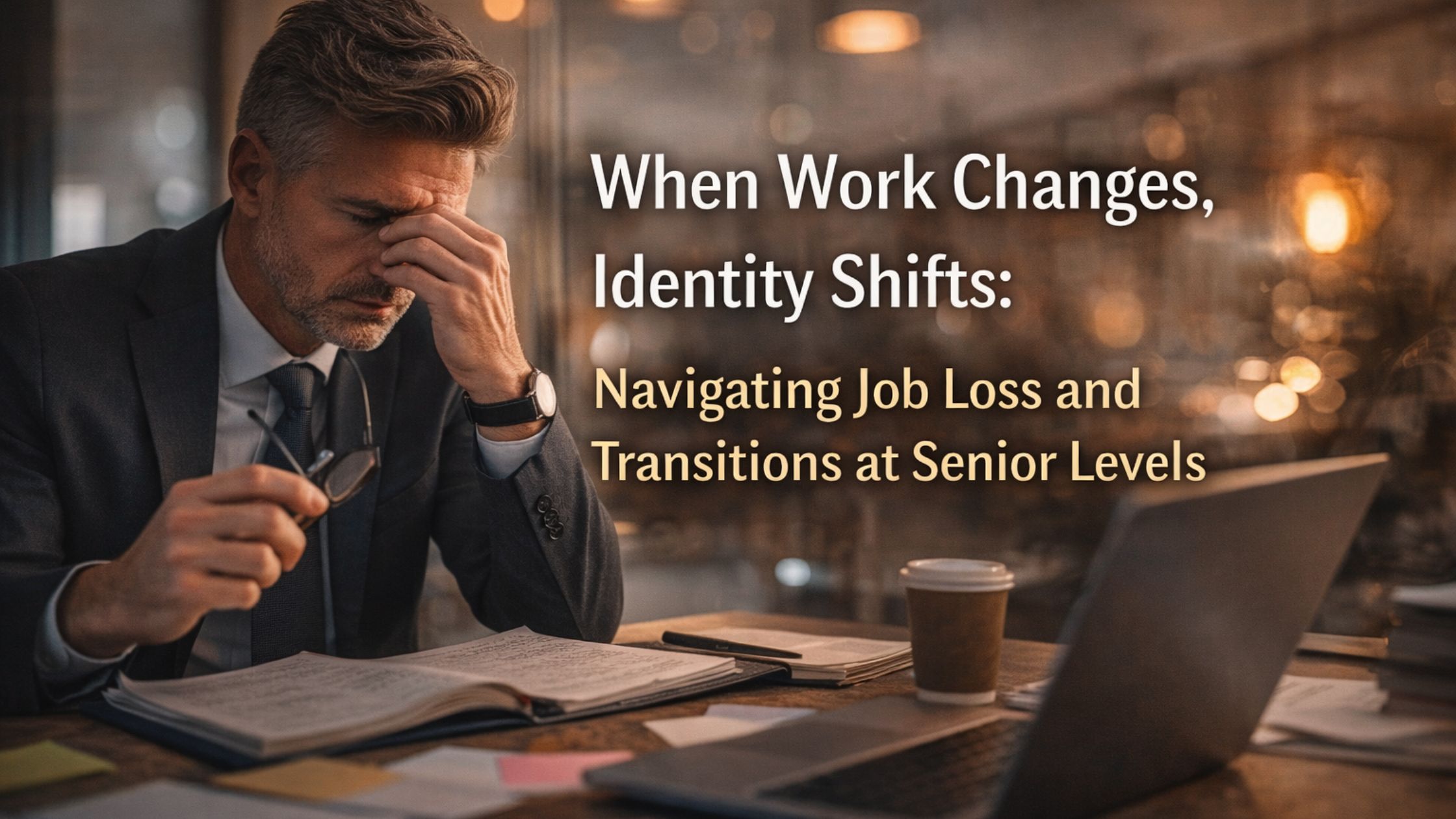
For many professionals at senior levels, work is not just a role it becomes a part of identity.
Years of experience, leadership, decision-making, and responsibility slowly shape how one sees themselves. Titles, teams, and impact begin to feel like extensions of who they are. So when a job change or sudden layoff happens, the impact is not just professional. It can feel deeply personal.
This blog explores why identity feels shaken during such transitions, the stress it can create, and what helps rebuild a sense of direction.
Why Work Becomes So Tied to Identity
At senior levels, careers are built over decades.
There is investment of time, effort, reputation, and relationships. Success is not just measured in outcomes, but in influence and contribution. Over time, the line between what you do and who you are can blur.
So when that role changes or disappears, it can feel like losing a part of oneself.
The Emotional Impact of Job Loss or Transition

The experience is rarely just about finding the next opportunity.
There can be a mix of emotions: shock, uncertainty, frustration, even grief. Questions begin to surface:
- What now?
- Was my value tied only to that role?
- How do I explain this to others?
There may also be a quiet sense of loss of control, especially when the change is unexpected.
These responses are natural. They reflect the depth of investment, not weakness.
Stressors Unique to Senior Professionals
Transitions at this stage often come with additional layers.
There may be financial responsibilities, family expectations, and lifestyle adjustments. There is also the pressure of finding a role that matches previous experience and status, which is not always immediate.
At the same time, there can be fewer peers to openly talk to, making the experience feel isolating.
The stress is not just about change it’s about uncertainty combined with expectation.
The Invisible Loss: Status and Structure
Beyond income, work provides structure, routine, and a sense of relevance.
At senior levels, it also brings recognition and authority. Losing that can create a sudden emptiness in daily life. Days may feel unstructured. Decisions that once felt clear may now feel uncertain.
This loss of rhythm can add to emotional strain.
Why Identity Feels Shaken
When identity is closely linked to a professional role, change can create a gap.
Without the familiar role, people may struggle to answer simple questions like, “What do I do?” or even “Who am I without this?”
This is not about lack of capability. It is about transition moving from a defined identity to a more open, uncertain space.
What Helps Hold Things Together During This Phase
Stability during transition doesn’t come from immediate answers. It comes from small anchors.
Maintaining routine, staying connected with trusted people, and keeping some structure in daily life can provide grounding. It also helps to separate identity from designation—recognising that skills, experience, and values remain, even when roles change.
This is a phase of redefinition, not disappearance.
Seeing Transition as Redirection
While difficult, transitions can also create space.
Some professionals explore consulting, mentoring, entrepreneurship, or completely new directions they may not have considered earlier. The shift is not always immediate, but over time, it can open different possibilities.
The focus moves from what was lost to what can still be built.
The Importance of Emotional Processing
Moving forward is not just about planning the next step.
It also involves acknowledging the emotional impact of the change. Ignoring feelings can delay clarity. Taking time to process them can create space for better decisions.
Support, whether personal or professional, can make this process less isolating.
When to Seek Support
Support may be helpful when stress feels overwhelming, confidence drops significantly, or uncertainty begins affecting daily functioning.
Having a space to talk through identity, direction, and emotional impact can bring clarity during a time that often feels unclear.
Conclusion
Job transitions at senior levels are not just career shifts, they are identity shifts.
Losing a role does not mean losing value. It marks the end of one chapter, not the end of contribution. With time, reflection, and the right support, new directions can emerge that still carry experience, insight, and purpose forward.
If you’re navigating such a transition and feeling uncertain about your next steps, SoulNirvana offers a supportive space through its Image Consulting services to help you reconnect with clarity and direction. If it feels right, you can book a session now and begin shaping your next chapter with confidence.
FAQs
Q1. Is it normal to feel lost after job loss at a senior level?
Yes. Identity is often closely tied to work at this stage.
Q2. How long does it take to adjust?
It varies. Adjustment involves both emotional processing and practical planning.
Q3. Can this phase lead to new opportunities?
Yes. Many professionals find new directions through reflection and exploration.
Q4. When should I seek help?
When stress, uncertainty, or low confidence begin affecting daily life.
References
American Psychological Association. Job loss and mental health.
Harvard Business Review. Identity and career transitions.
World Health Organization. Mental health and workplace transitions.
International Labour Organization. Employment transitions and well-being.