
A child today can have a room full of toys, a calendar full of activities, access to unlimited information, and parents who are trying harder than ever to provide the best.
More learning. More exposure. More opportunities. More experiences.
From the outside, childhood may look richer than ever before. Yet many children struggle to slow down, handle boredom, express emotions, or feel truly connected.
Maybe the question is not always, "Are we giving our children enough?"
Maybe sometimes the question needs to be, "Is there too much around them to notice what they actually need?"
Simplicity parenting is not about giving children a boring life or taking opportunities away. It is about understanding that children need space, calm, and connection just as much as they need growth and achievement.
The Noise We Don’t Always Notice
When we think about noise, we usually imagine loud sounds, television, phones, traffic, or constant distractions.
But children today experience another kind of noise too.
The noise of expectations. The noise of choices. The noise of comparison. The noise of always needing to become better at something.
Even things done with good intentions can sometimes become overwhelming. A child may move from school to tuition, from tuition to activities, from activities to screens, without enough time to simply pause.
Slowly, their days become full, but their inner world gets very little space. Children are not only developing skills. They are developing their sense of self. And that needs quiet moments too.
When Childhood Becomes Too Full
Many adults remember childhood moments that were surprisingly simple.
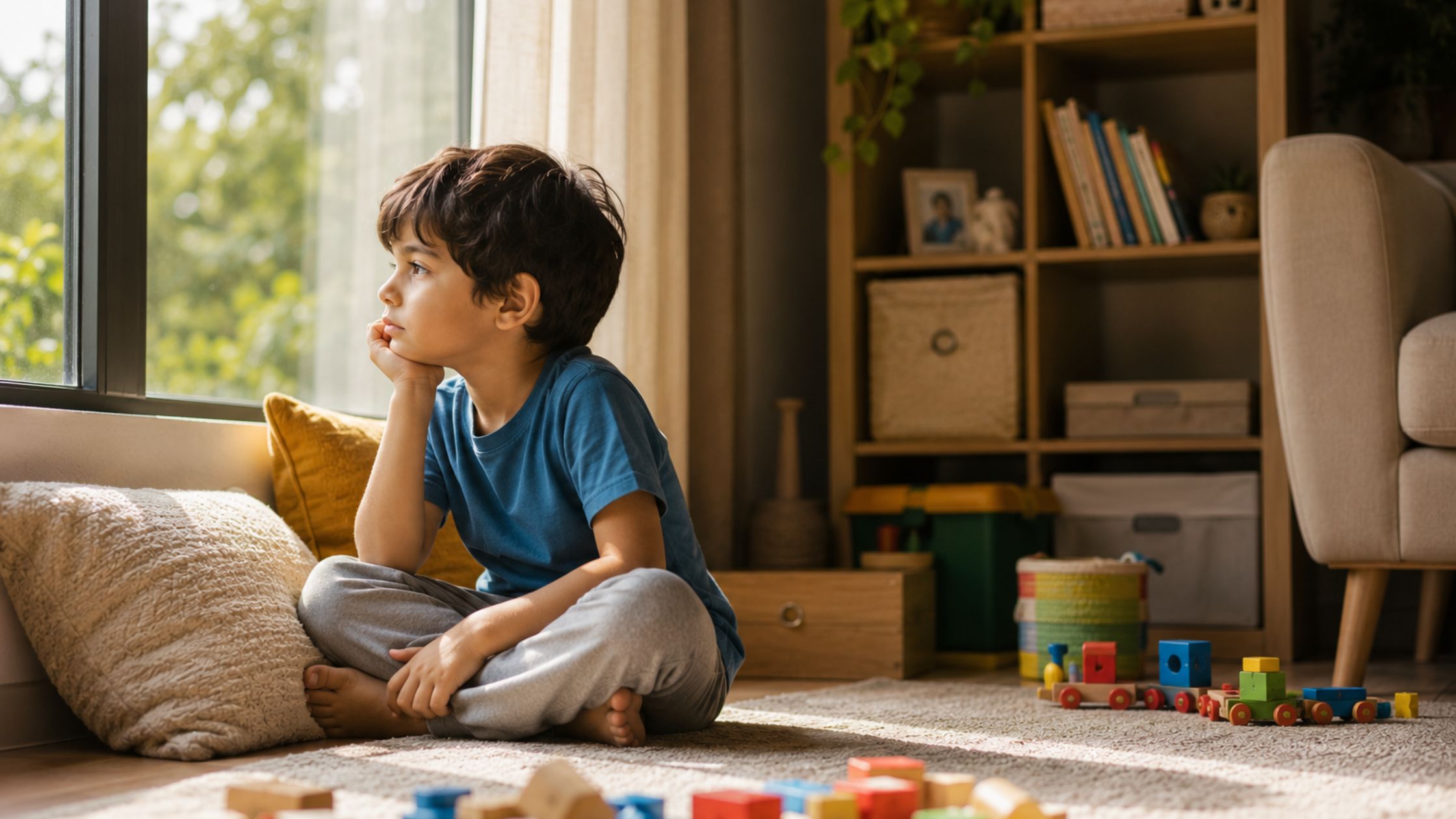
Playing without a fixed plan. Creating games out of nothing. Sitting quietly. Feeling bored and then finding something imaginative to do.
Today, boredom almost feels like a problem that needs to be solved immediately.
A quiet moment gets filled with a screen.
A free evening gets replaced with another activity.
A gap in the day becomes something to manage.
But boredom is not always empty. For children, these slower moments create room for imagination, creativity, problem-solving, and understanding their own thoughts.
When every moment is filled from the outside, children get fewer chances to discover what comes from within.
Are We Connecting or Managing?
This is one of the biggest challenges of modern parenting. Many parents spend a lot of time around their children, but much of that time gets consumed by managing life.
"Finish your homework."
"Get ready quickly."
"Did you complete your work?"
"Don't forget your class."
"Why haven't you done this yet?"
These conversations are necessary. Structure and responsibility matter.
But somewhere between schedules, routines, and responsibilities, parents and children can start functioning like a team completing tasks rather than two people experiencing a relationship.
A child can be well cared for and still quietly crave emotional connection.
They may not always remember whether everything was perfectly organised, but they remember how they felt around their parents.
The Difference Between Attention and Connection
Children receive a lot of attention today. Parents think about their future, their education, their activities, their nutrition, their development, and their opportunities.
But attention and connection are not always the same.
Attention asks: "What does my child need to achieve?"
Connection asks: "Who is my child becoming?"
Attention notices performance. Connection notices feelings. Attention looks at the result.
Connection understands the experience. Children need both. But when life becomes too busy, connection is often the first thing that quietly gets pushed aside.
The Child Behind the Achievements
Every child is more than what they accomplish.
More than marks. More than talents. More than milestones. More than what they become in the future.
Sometimes, in trying to prepare children for tomorrow, adults forget to meet who they are today.
What makes them laugh? What scares them? What questions do they carry?
What do they enjoy when nobody is measuring the outcome?
A child who feels understood develops something deeper than confidence. They develop emotional security.
They learn, "I am valued not only for what I do, but for who I am."
Why Simple Moments Stay the Longest
When children grow up, their strongest memories are often not the most expensive or perfectly planned moments.
They remember small things. A conversation before sleeping. Laughing about something silly.
Cooking together. Being comforted after a difficult day. A parent listening without immediately correcting.
These moments may look ordinary, but emotionally they communicate something powerful: "I see you. I enjoy being with you. You matter."
Connection is usually built quietly through repeated moments of presence.
Simplicity Is Not About Doing Less for Your Child
Many parents worry that slowing down means their child will miss opportunities.
But simplicity parenting is not about removing growth. It is about creating balance.
Children need learning, experiences, and challenges. They also need rest, emotional safety, and space to understand themselves. A child’s life does not have to be constantly full to be meaningful.
Sometimes less pressure creates more confidence. Less rushing creates more awareness. Less noise creates more connection.
Conclusion
Simplicity parenting is not about stepping backward. It is about remembering what children have always needed at the centre of everything—connection.
In a world offering endless choices, information, and stimulation, one of the greatest gifts parents can give children is the feeling of being truly seen.
Not only when they succeed. Not only when they achieve. But in ordinary moments when they are simply themselves.
If you feel parenting today has become overwhelming, or you want to build a deeper emotional connection with your child, SoulNirvana offers support through its Comprehensive Parenting Support Program. It provides a safe space to understand your child's emotional world and strengthen your relationship with them.
Take the first step towards creating a calmer, more connected parenting journey by booking a session now.
FAQs
Q1. Does simplicity parenting mean giving children fewer opportunities?
No. Simplicity parenting is not about limiting children. It is about creating balance between opportunities, rest, emotional connection, and personal growth.
Q2. Why do children need unstructured time?
Unstructured time allows children to develop imagination, independence, problem-solving skills, and the ability to understand themselves better.
Q3. Can too many activities overwhelm children?
Yes, sometimes. Even positive activities can become stressful if children don't have enough time to rest, reflect, and simply enjoy being children.
Q4. How can parents build stronger connections with children?
Through small daily moments—listening, being emotionally present, creating safe conversations, and spending time together without constant distractions.
References
Kim John Payne. Simplicity Parenting: Using the Extraordinary Power of Less to Raise Calmer, Happier, and More Secure Kids.
https://www.simplicityparenting.com
Center on the Developing Child, Harvard University. Child Development and Responsive Relationships.
https://developingchild.harvard.edu
American Psychological Association. Parenting and Child Development.
https://www.apa.org/topics/parenting
UNICEF. Child Development and Positive Parenting.