
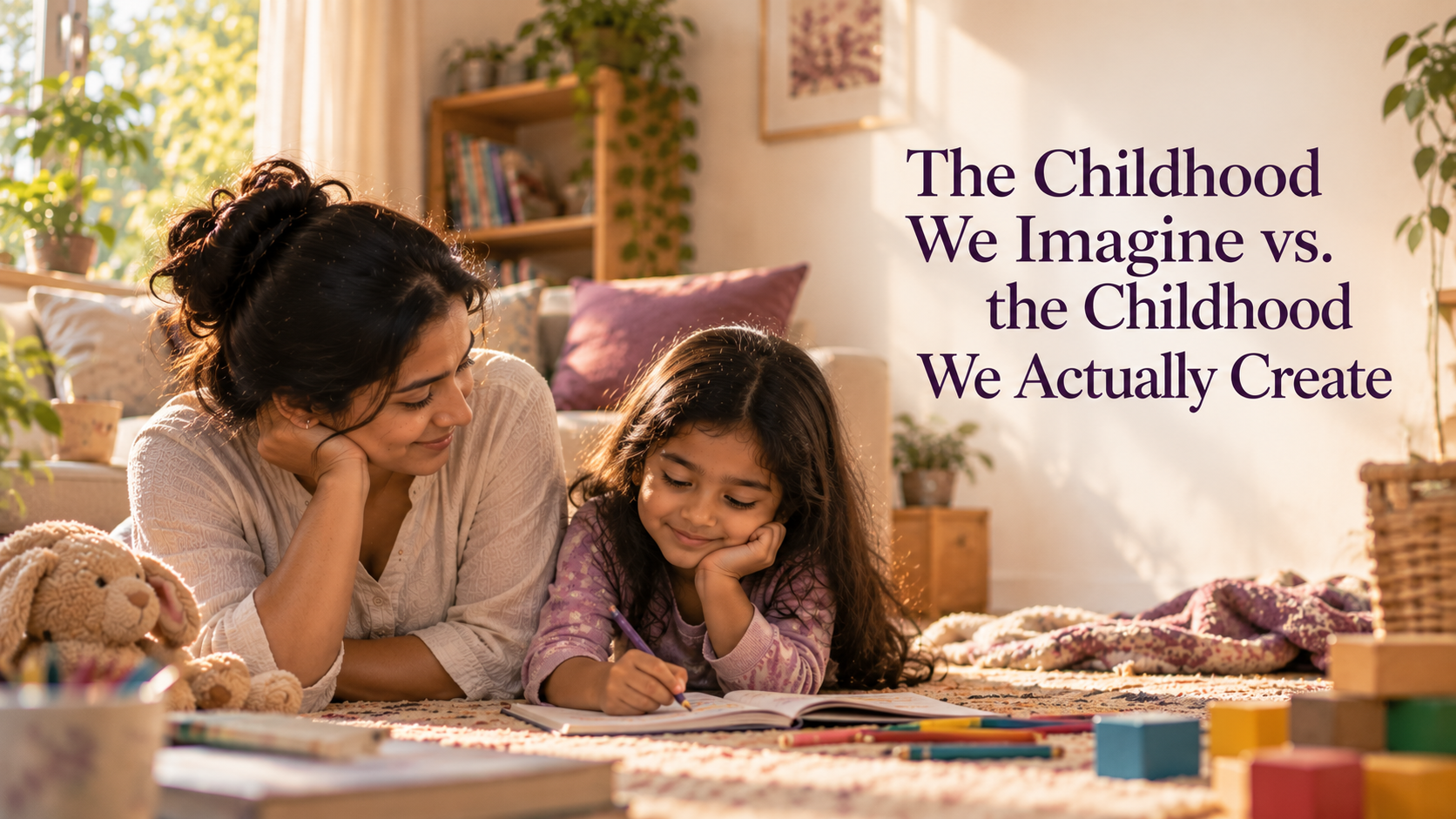
Most parents carry an image of the childhood they want to give their children. It may be a childhood filled with connection, imagination, family meals, meaningful play, emotional security, laughter, curiosity, and enough freedom for a child to discover who they are.
Yet the childhood we imagine and the childhood created by everyday life can slowly become two different things.
The home may be filled with toys bought with love, yet there is little space to play. The calendar may be filled with activities chosen to support a child’s interests, yet there is hardly any unscheduled time. Parents may want more family connection, yet evenings disappear into screens, rushing, and unfinished responsibilities. They may want their children to feel secure, yet their own worries can quietly fill the atmosphere of the home.
This gap does not necessarily come from a lack of love or intention. Often, it develops because modern family life gradually accumulates more than anyone consciously chose.
Simplicity parenting offers a way to look at that gap differently. Simplification is not about creating a deprived childhood. It is about bringing everyday life back into alignment with what parents actually hope childhood will feel like.
The Childhood We Hope to Give
Parents often imagine childhood in terms of experiences that cannot be bought or scheduled. They hope their children will have time to play, become curious, build relationships, develop confidence, and feel deeply known and cared for.
They want their children to have room to imagine rather than simply consume. They want family life to include ordinary moments of togetherness rather than feeling like a series of transitions between obligations. They want their children to develop resilience, but also want them to experience the security of knowing that someone will notice when something is wrong.
These hopes matter because they reveal what parents value.
The difficulty is that daily life can begin moving in another direction. The home becomes more crowded. The schedule becomes fuller. Screens become more present. Choices multiply. Quiet moments become harder to find. Parents become increasingly concerned about whether they are doing enough for their children.
Gradually, the things that were meant to support childhood can begin competing with childhood itself.
The question, then, is not simply whether a particular toy, activity, screen, or schedule is good or bad. It is whether the overall shape of family life still reflects the childhood parents hoped to create.
When More Slowly Becomes Too Much
Much of what surrounds children begins with good intentions.
More toys can seem like more opportunities for play. More activities can seem like more opportunities to discover abilities. More choices can seem like more independence. More information can seem like better preparation for the world.
But accumulation has consequences.
When there are too many toys, children may find it harder to settle into deep play. When the schedule contains too many activities, there may be little time for downtime or free exploration. When there are too many choices, simple decisions can become unnecessarily demanding. When sensory input is constantly changing, quiet can begin to feel unfamiliar.
The same principle applies to the emotional environment.
Children can also experience too much adult worry, too much media exposure, too much questioning, and too much involvement. A parent may be trying to protect a child while unintentionally leaving very little room for the child to simply experience childhood.
This is why simplicity is broader than tidying a room or reducing possessions. It asks families to notice everything that fills a child's world.
Sometimes, the most meaningful change comes not from adding something better, but from removing what has become unnecessary.
A Home Can Be Full Without Feeling Connected
A family can spend a great deal of time together and still experience very little connection.
Everyone may be in the same room, but each person is occupied with a different screen. A parent may be physically present while mentally absorbed in worries and responsibilities. Children may have endless entertainment available but very little opportunity to become absorbed in shared experiences.
Connection often develops through much simpler moments.
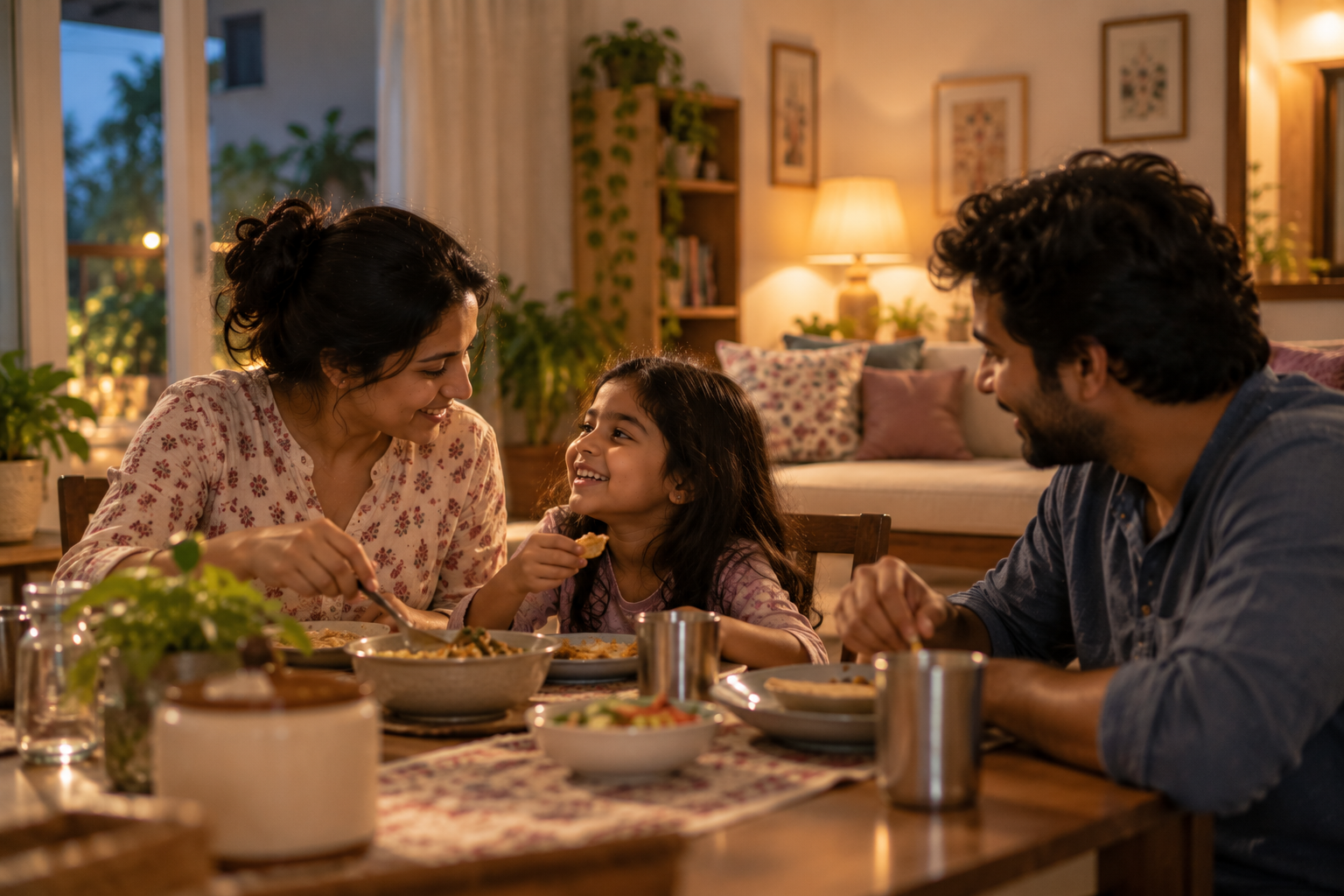
It can happen during a meal, while preparing food, during a bedtime story, while completing an ordinary household task, or in the quiet spaces between planned activities. These moments do not need to be turned into special family experiences. Their value often comes from being ordinary and repeated.
Relationships grow through presence.
A child does not necessarily need another carefully planned activity with a parent. Sometimes they need the parent who is available, attentive, and willing to share the unremarkable parts of the day.
A simpler family life can create more opportunities for those moments to occur naturally.
Making Room for the Child Behind the Schedule
A busy schedule can sometimes make it difficult to notice the child underneath it.
A child may love an activity, but that does not mean they need more and more of it. An interest can remain an interest without immediately becoming a structured pursuit. Children need time for their abilities and preferences to develop gradually.
When every interest becomes something to improve, measure, or master, childhood can begin to feel like a continuous preparation for something else.
Unscheduled time offers another possibility.
A child may spend an afternoon doing something that appears unimportant. They may play, daydream, become bored, change activities, return to something familiar, or invent a game that makes little sense to an adult. Yet, within that freedom, they are experiencing childhood on their own terms.
Free play gives children room to explore without an adult deciding what the experience should produce. UNICEF also describes free play as an opportunity for children to choose their materials, interests, and direction, with independent play supporting creativity, imagination, and growing independence.
The point is not to remove meaningful activities from a child's life. It is to make sure that activities do not leave childhood without room to breathe.
Security Is Built Through the Ordinary
The childhood parents imagine often includes emotional security, but security is not created only during major moments.
It develops through repeated experiences of care.
A familiar meal, a predictable bedtime rhythm, a shared story, a parent noticing when something is wrong, or a quiet moment of closeness can become part of a child's experience of belonging. These repeated moments give daily life a recognisable shape.
Children do not need every day to unfold perfectly. They need dependable relationships within the ordinary unpredictability of life.
Research from Harvard's Center on the Developing Child similarly emphasises the importance of responsive relationships and stable, supportive environments in children's development.
This makes simplicity less about controlling a child's environment and more about protecting the conditions in which connection can happen.
A calmer rhythm can make it easier for parents to notice their children, and easier for children to know where they belong.
The Adult World Can Quietly Enter Childhood
Parents cannot separate children completely from the wider world, nor should they try to create a life where nothing difficult exists. But childhood does not need to carry every concern that belongs to adulthood.
Constant exposure to screens, media, fear, hurried conversations, and adult worries can change the emotional atmosphere of a home. Children notice more than adults sometimes realise. They can absorb the tension and urgency around them even when the subject of that concern is not directly discussed with them.
Filtering the adult world is therefore part of simplifying childhood.
This can mean being thoughtful about what children are exposed to, reducing unnecessary media saturation, and becoming more aware of how much adult worry enters everyday conversations.
It can also mean saying less.
When parents constantly question, explain, correct, or interpret a child's experience, there may be less room for the child to simply be. A calmer presence can sometimes communicate more than another explanation.
The goal is not silence or emotional distance. It is to make the home a place where children do not have to carry concerns that are not theirs.
Simplification Is a Realignment, Not a Deprivation
One of the biggest misunderstandings about simplicity is that less automatically means less.
Less clutter does not have to mean less play.
Less scheduling does not have to mean fewer opportunities.
Less screen exposure does not have to mean less entertainment.
Less parental intervention does not have to mean less care.
In the context of parenting, simplifying can actually make room for more of what families say they want most.
Fewer toys can create more focused play. Fewer activities can create more downtime. Fewer distractions can create more attention. Less adult interference can create more independence. Less media exposure can create more room for conversation and imagination. A calmer rhythm can create more opportunities for connection.
This is why simplification is better understood as realignment.
It asks families to look at the distance between their values and their routines and consider whether everyday life still supports those values.
The Courage to Let Childhood Unfold
Parents naturally want to protect their children. They also want to give them every possible advantage. These hopes can sometimes create a fear of leaving anything out.
What if the child misses an opportunity?
What if they fall behind?
What if more activity, more learning, or more involvement would help them become more capable?
Yet childhood cannot be built entirely through addition.
Children need experiences that cannot be scheduled into a calendar. They need time to play without an objective, rest without guilt, become bored without immediate entertainment, and discover interests without pressure to turn them into achievements.
They also need parents who can distinguish between genuine needs and the fears that make everything feel urgent.
Protecting childhood does not mean protecting children from every difficulty. It means creating enough security and space for them to encounter life gradually.
A child who knows they are cared for does not need every part of the world managed for them.
Bringing Everyday Life Closer to What Matters
The most useful question in simplicity parenting may not be, “What should we remove?”
It may be, “What kind of childhood are we trying to create?”
If the answer includes connection, then family life may need more unhurried moments together.
If the answer includes imagination, children may need more unstructured play.
If the answer includes security, they may need familiar rhythms and dependable care.
If the answer includes independence, parents may need to leave some experiences for children to navigate themselves.
If the answer includes appreciation of ordinary life, the family may need fewer distractions competing for attention.
This is where simplification becomes meaningful. It is not about following another parenting formula. It is about bringing the details of everyday life closer to the hopes that gave parenting its direction in the first place.
The environment around a child matters, and current developmental science continues to emphasise that relationships and broader developmental environments shape children's experiences and development.
The question is therefore not whether a family can create a perfect childhood. No family can.
The question is whether the life being created each day gives childhood enough room to be experienced as childhood.
Conclusion
The childhood we imagine is usually made up of simple things: a child who feels secure, a family that has time for one another, a home where imagination has room, and a child who can grow into themselves without being hurried.
The childhood we actually create can become more complicated. It can become crowded with possessions, activities, choices, screens, schedules, adult concerns, and the pressure to keep doing more.
Closing that gap does not require parents to start over.
It may begin with noticing what has become too much and deciding what can become quieter. It may mean protecting an afternoon without plans, putting fewer toys within immediate reach, creating familiar family rhythms, reducing unnecessary media exposure, or allowing a child to remain with their own play without turning it into a lesson.
These changes are not about giving children less of life. They are about making enough room for them to experience more of what childhood needs most: attention, imagination, connection, security, play, and time.
At SoulNirvana, the Parenting Support Program offers parents a space to reflect on the difference between the family life they hope to create and the patterns that everyday life may have gradually established, with support in finding a more connected and sustainable way forward. Sometimes, realignment begins with a simple recognition: the childhood we want for our children may already be possible, but it may need a little more space to emerge.
FAQs
What does simplicity parenting really mean?
Simplicity parenting is about reducing unnecessary excess in a child's environment and daily life so there is more room for connection, play, attention, rest, and gradual development. It is broader than simply having fewer toys.
Does simplifying childhood mean giving children less?
Not necessarily. Simplification can remove distractions and unnecessary demands while creating more opportunities for meaningful play, family connection, downtime, and independence.
How can parents know if family life has become too complicated?
Parents can look at whether the family's daily life still reflects what they value. If clutter, constant activity, screens, rushing, or adult concerns are leaving little room for connection and calm, some simplification may be worth considering.
Why is unstructured time important?
Unstructured time allows children to play, imagine, become bored, follow their interests, and discover what they want to do without constant adult direction. Play is also recognised as an important part of children's learning, development, and connection.
Is simplicity parenting about creating a perfectly calm home?
No. Family life will always contain interruptions, busy periods, and unexpected situations. The aim is not perfection, but creating enough rhythm, space, and connection for childhood to unfold without unnecessary excess.