
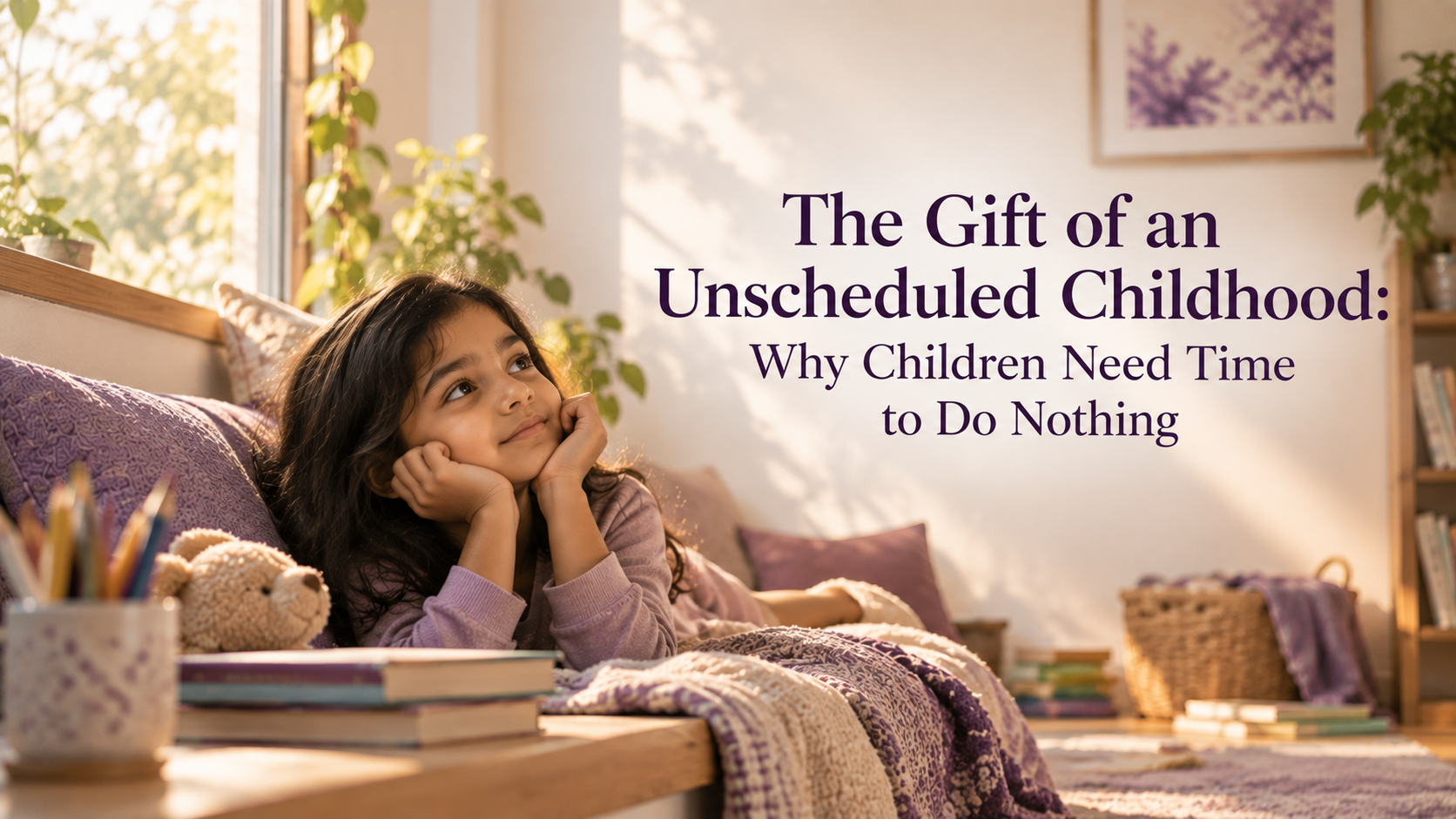
Childhood does not need to be filled from morning to night to be meaningful. There are moments when a child is not learning a new skill, attending an activity, completing a task, or being entertained, and yet something important may still be happening. A child may be lying on the floor, looking out of a window, repeating the same game, inventing a story, or simply wondering what to do next.
For adults, these moments can sometimes look like wasted time. There may be a temptation to fill them with another activity, suggest something useful, or turn an emerging interest into an opportunity for development. But childhood needs a different pace. Children need time to experience ordinary life, follow their own curiosity, become bored, imagine, play, and discover what emerges when nobody tells them what comes next.
This is one of the deeper ideas behind simplicity parenting. Simplifying childhood is not only about reducing possessions or creating calmer surroundings. It is also about protecting time that does not have to produce anything. An unscheduled part of the day can give a child something that a tightly organised schedule cannot: room to become absorbed in their own world.
When Every Hour Has a Purpose
It is easy for a child’s schedule to become full without anyone deliberately intending it. School, activities, interests, appointments, outings, practice, family responsibilities, and entertainment can gradually leave very little time between one thing and another.
Many of these experiences may be valuable. A child may genuinely enjoy an activity and look forward to participating in it. The difficulty comes when activity itself becomes the measure of a good childhood, and every available space is treated as an opportunity that needs to be filled.
A full schedule can also create the impression that childhood abilities must constantly be developed. If a child enjoys drawing, the next step may become a class. If they enjoy music, it may become lessons. If they are interested in sport, it may become regular training. A natural interest can quickly become something that has to be improved, measured, or pursued.
There is nothing wrong with helping children explore their interests. But an interest does not always need to become a project. Sometimes a child needs to enjoy something simply because they enjoy it.
Children need time for abilities and interests to unfold rather than being hurried into achievement. What begins as a small curiosity may become meaningful over time when it is given enough space to grow naturally.
Boredom Is Not Always Something to Fix
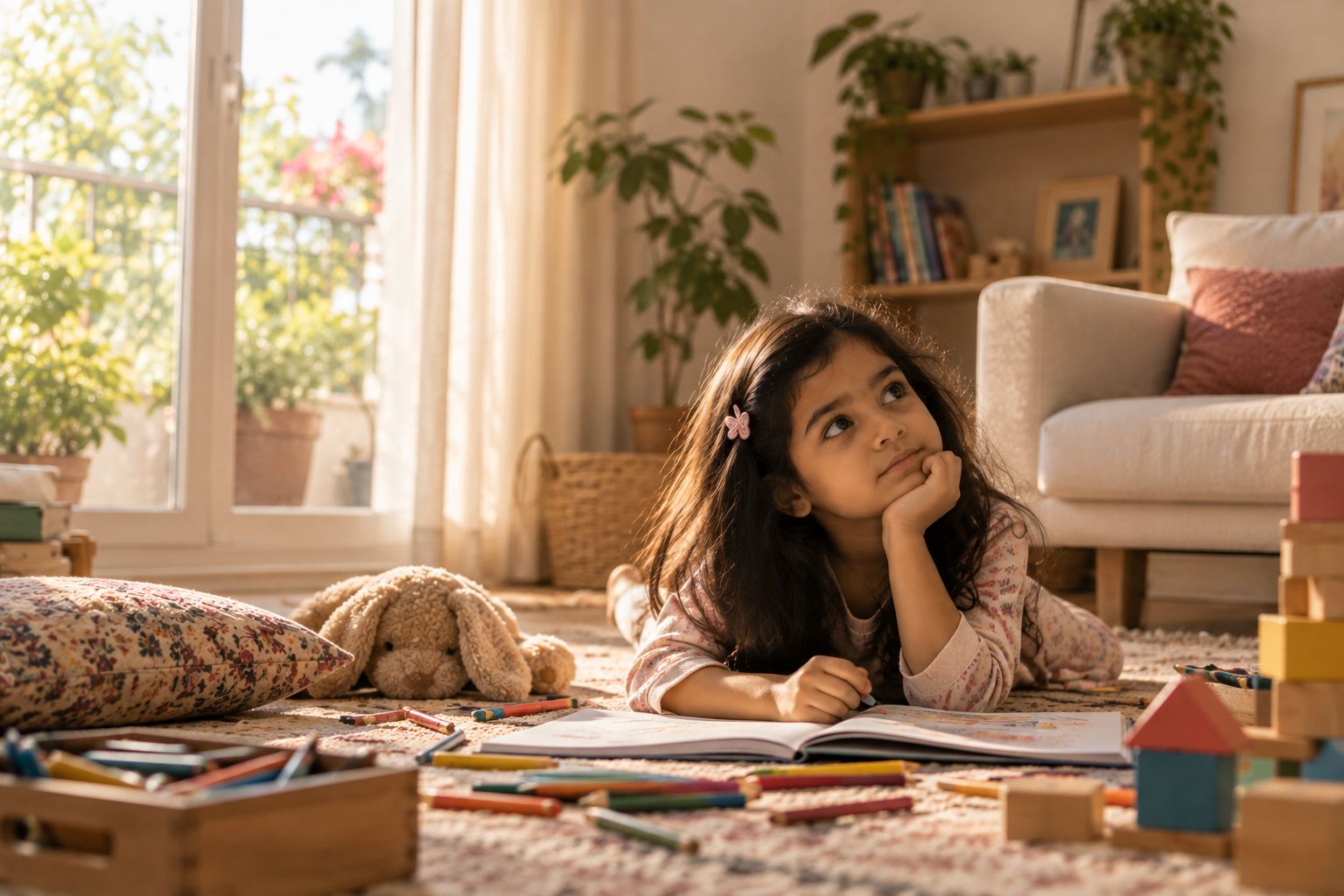
When a child says, “I’m bored,” the immediate instinct may be to find something for them to do. Parents may suggest a game, offer a screen, bring out a toy, organise an activity, or propose something educational.
But boredom can also be the beginning of something.
When there is nothing immediately provided, a child has to encounter the space between activities. At first, that space may feel uncomfortable. There is no ready-made entertainment and no adult instruction about what should happen next. Eventually, however, the child may begin looking around, remembering something, creating something, or returning to an interest that had been overlooked.
Boredom can make room for daydreaming and imagination. A child may invent a game from ordinary objects, create an elaborate story, draw without a particular purpose, or simply sit and observe. These experiences may not look productive, but they belong to the natural messiness of childhood.
The value of boredom is not that children should be deliberately left without attention or care. It is that they do not need every empty moment to be immediately filled.
Free Play Has Its Own Direction
Free play is different from an activity designed by an adult for a particular outcome. In free play, children can decide what interests them, how long they want to remain with it, and where their imagination takes them.
The play may not make sense to an adult. A child may repeat the same action, change the rules halfway through, abandon one idea and return to another, or create a story that seems completely disconnected from reality. That flexibility is part of the experience.
Children need opportunities to explore without constantly being directed toward a result. They can discover what holds their attention and what they want to return to when there is no adult-designed objective waiting at the end.
This is also why play does not always need to be made more exciting. When children are surrounded by too many toys, activities, and sources of stimulation, their attention may move quickly from one thing to another. A simpler environment can allow them to stay with an activity for longer and discover more within it.
Sometimes, the best thing an adult can do for a child's play is to make room for it and let it happen.
The Importance of Anticipation
An unscheduled childhood is not only about what happens during free time. It is also about what children experience while waiting for something they care about.
Anticipation has its own place in childhood. Waiting for a family outing, a favourite meal, a story, a visit, or an event allows a child to imagine what is coming. The experience is not limited to the event itself. The waiting becomes part of it.
When everything is provided immediately, there may be fewer opportunities for children to experience this gradual build-up of expectation. A constant stream of activities and entertainment can make one experience quickly replace another.
Anticipation gives an experience room to exist before it happens. It allows children to wonder, imagine, and become emotionally involved with what is still to come.
This matters because childhood is not only about collecting experiences. It is also about learning to inhabit the time before, during, and after them.
Why Downtime Belongs in the Rhythm of Family Life
A family rhythm needs both activity and rest. Just as a day can contain meals, responsibilities, play, and shared activities, it also needs periods when nothing particular is required.
Without downtime, activity can become exhausting. Children may move from one experience to another without having enough time to settle, absorb what has happened, or return to their own interests.
Downtime does not have to mean sitting still. It may look like quiet play, drawing, reading, building something, wandering around the house, looking outside, or simply deciding what to do next.
These quieter periods can also help balance more intense parts of the day. A busy outing can be followed by a calmer afternoon. A stimulating activity can be followed by time at home. A day full of movement can be balanced by a slower one.
The point is not to create an empty childhood. It is to create a childhood with enough variation that children are not expected to remain stimulated all the time.
When Development Becomes a Constant Project
Parents naturally want their children to grow, learn, and discover their abilities. That hope can sometimes become a pressure to keep adding opportunities.
A child may begin to feel as though every interest has to become a skill and every skill has to become an achievement. Their activities may be chosen not only because they enjoy them, but because adults believe they will be useful later.
The problem with this approach is not the desire to support development. It is the assumption that development must always be actively pushed.
Some abilities need time to emerge. Some interests need room to change. A child may spend weeks or months doing something that appears repetitive before moving toward something new. What looks like inactivity may actually be part of the process through which the child discovers what matters to them.
Children are not projects that need constant improvement. Their development has its own pace, and simplifying their schedules can allow parents to observe that pace rather than continually trying to accelerate it.
The Messiness of Free Time Matters
Unstructured time rarely looks impressive. It may produce a room that becomes messy, a game that makes little sense, an unfinished drawing, or a story that changes several times.
There may be no obvious outcome.
That does not make the time meaningless.
When children have freedom to play, they also have freedom to change direction. They can experiment, fail, begin again, become absorbed, lose interest, and return later. They can discover that an activity does not have to be perfect to be enjoyable.
This flexibility matters because childhood is not supposed to look like a series of completed achievements. There is value in the unfinished and the unexpected.
A child who is allowed to play without constantly being corrected or redirected may gradually become more comfortable following their own curiosity. The adult does not need to make every moment educational. Sometimes, allowing the child to decide what the moment becomes is enough.
Parents Need Downtime Too
Children learn about balance partly by observing the adults around them. If parents are constantly rushing, organising, working, planning, and filling every quiet moment, children may come to experience busyness as the normal shape of life.
Creating downtime for children can therefore begin with recognising the value of downtime within family life itself.
A quieter evening, an unhurried meal, time spent doing an ordinary household task, or simply allowing a period of the day to remain unplanned can communicate something important: not every moment needs to be productive.
This does not require parents to create a perfectly calm household. Family life will always contain responsibilities and unexpected demands. The intention is simply to leave some room for a slower pace.
When children see that adults can pause without immediately reaching for another task or source of stimulation, rest becomes part of ordinary life rather than something that has to be earned.
Giving Childhood Back Its Own Pace
There is a particular kind of pressure that comes from believing that children must always be doing something. The pressure may come from comparison, from fear that an opportunity will be missed, or simply from the feeling that a child’s time should never be wasted.
But childhood does not need to be constantly optimised.
Children need time to discover what interests them without being hurried toward mastery. They need time to play without an outcome. They need time to become bored without being immediately rescued from it. They need time to daydream, anticipate, rest, and return to ordinary experiences.
An unscheduled childhood does not mean neglecting a child’s needs or removing meaningful activities from their lives. It means recognising that some of the most important experiences cannot be scheduled in advance.
Curiosity often appears when there is room for it. Imagination often needs freedom. Interests can deepen when they are not constantly directed. And a child’s relationship with ordinary life can become richer when every quiet moment is not treated as something that needs to be filled.
Conclusion
Perhaps one of the simplest gifts a parent can offer is the permission to have time that does not need to lead anywhere.
A child does not need every hour to produce a skill, an achievement, or a memorable experience. Sometimes, they need an afternoon with nothing planned, a quiet corner, a few familiar things to play with, and enough time to discover what happens when nobody tells them what to do next.
Simplicity creates that possibility. It allows childhood to have pauses, and those pauses can become spaces for imagination, exploration, anticipation, and rest.
At SoulNirvana, the Parenting Support Program provides parents with a space to reflect on the pace, expectations, and patterns within family life and to think about what may help create greater connection and balance at home. Sometimes, supporting a child’s development does not mean adding another opportunity to the calendar. It may simply mean protecting a little more of the time that already belongs to childhood.
FAQs
Why do children need unstructured time?
Unstructured time gives children opportunities to play, imagine, daydream, follow their interests, and decide what to do without constant adult direction. It allows childhood to unfold at a less hurried pace.
Is boredom good for children?
Boredom can create space for children to discover their own ideas and interests rather than relying on constant entertainment. It does not need to be immediately solved with another activity.
Does free time mean children should have no activities?
No. Meaningful activities can be part of childhood. The focus is on creating a balance between organised experiences and enough downtime for children to rest, play freely, and explore at their own pace.
Why can overscheduling become a concern?
When too much of a child’s time is structured around activities, there may be less room for free play, downtime, anticipation, and independent exploration. Even activities a child enjoys can become tiring when there is too much, too soon.
Do children need to develop their abilities constantly?
Children naturally develop through everyday experiences, play, relationships, and exploration. Not every interest needs to become a structured skill or achievement; some interests need time and freedom to unfold.