
The Overstimulated Childhood: When “More” Starts Becoming Too Much
14 Sept 2026
The Overstimulated Childhood: When “More” Starts Becoming Too Much
Childhood is often imagined as a time of discovery, curiosity, play, and wonder. It is a period when children gradually learn who they are, what interests them, how relationships work, and how to respond to the world around them. Yet, in many families, childhood is increasingly surrounded by more of everything: more toys, more activities, more choices, more sounds, more screens, more information, and more expectations.
Although these additions may come from love and good intentions, they can sometimes create an environment that feels difficult for a child to process. When there is too much happening around them, children may struggle to remain attentive, settle down, play deeply, or understand what they are feeling. What appears to be restlessness, disinterest, irritability, or difficult behaviour may sometimes be connected to an environment that has become overwhelming.
This does not mean that children need an empty home, a completely quiet routine, or a childhood without stimulation. It means that they need enough space between experiences for their attention, imagination, emotional security, and individuality to develop. Simplicity is not about giving children less love, less opportunity, or less joy. It is about reducing unnecessary excess so that what truly matters has room to be experienced more deeply.
When Childhood Becomes Too Full
Modern family life can become crowded without anyone deliberately choosing to make it that way. A child may have a room filled with toys, a schedule full of activities, several forms of entertainment, constant background noise, and frequent exposure to adult concerns through conversations or screens. Each element may seem harmless on its own. Together, however, they can create a pace that is difficult for childhood to follow.
Children are still developing the ability to manage attention, respond to emotions, move between activities, and understand their surroundings. When they are continually exposed to new objects, sounds, instructions, choices, and experiences, they may have fewer opportunities to pause and process what is happening. Their environment may keep demanding attention before they have had time to become fully engaged with anything.
This excess can also affect the way children experience ordinary life. When every moment is filled with entertainment or activity, quiet moments may begin to feel uncomfortable. When every interest is quickly replaced by something new, children may find it harder to stay with one activity long enough to discover its depth. When there are too many choices, even simple decisions can become tiring.
The concern is not that every busy day is harmful or that every stimulating experience should be avoided. The deeper concern is whether a child’s everyday life contains enough balance, predictability, and breathing space.
Too Much Stuff Can Leave Too Little Room for Attention
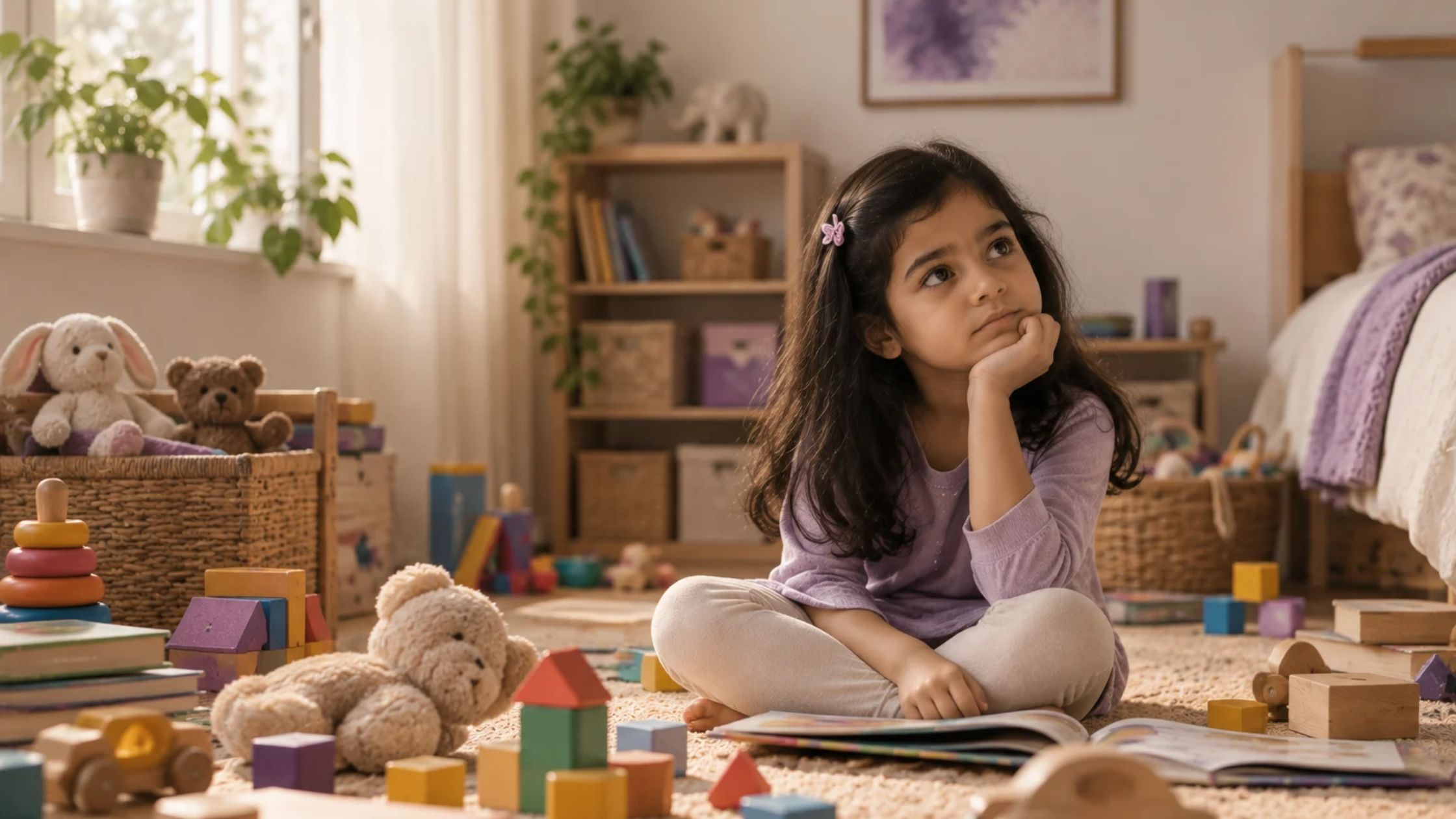
Toys are an important part of childhood. They can invite imagination, support exploration, and become companions in a child’s play. However, when too many toys are immediately visible and accessible, they may compete for the child’s attention rather than support it.
A room crowded with objects can make it difficult for a child to decide where to begin. One toy may lead to another, and another may quickly replace it. Instead of becoming absorbed in a meaningful activity, the child may move from one object to the next without developing a deeper relationship with any of them.
Reducing the number of toys that are visible does not mean taking play away. It can create a more manageable environment in which a child is able to notice what is available and engage with it more fully. A few familiar and beloved toys may offer more opportunities for sustained play than a large collection that is constantly competing for attention.
Some toys can be stored and brought out at different times. This allows the environment to change without becoming overwhelming. It also gives children the opportunity to rediscover objects that may have become less noticeable when surrounded by too many alternatives.
The purpose is not to create a perfectly organised room. It is to create a space where children can move, imagine, build, draw, read, and explore without feeling surrounded by constant demands on their attention.
The Difference Between Activity and Deep Engagement
Children may enjoy many activities, but enjoyment does not always mean that more activity is better. A child may love music, sports, art, reading, outings, or structured classes and still need time away from them. Even something meaningful can become tiring when there is too much of it, too soon, or without enough recovery time.
A schedule filled with activities can leave little room for the slower forms of learning that happen naturally during childhood. Children need time to follow an idea, make a mess, change direction, become bored, and discover something without an adult directing every step. These experiences may appear unproductive from the outside, but they allow children to develop curiosity and inner flexibility.
Free play is not always neat or predictable. It may involve repetition, unfinished games, unusual stories, or activities that do not seem to have a clear purpose. Yet, this freedom is part of its value. Children are able to explore their interests at their own pace rather than constantly responding to an adult-designed outcome.
When the day contains both activity and downtime, children have more opportunities to absorb what they have experienced. They can move from excitement toward calm, from effort toward rest, and from being guided toward discovering something independently.
A child’s interests and abilities need time to develop. They are more likely to become lasting sources of enjoyment when they are not hurried, over-managed, or treated as achievements that must constantly be improved.
Too Many Choices Can Become Overwhelming
Choice can support independence, but an excess of choice can make ordinary moments unnecessarily difficult. Deciding what to wear, what to play with, what to eat, what to watch, or what to do next may become tiring when every possibility is placed in front of a child.
Children benefit from having some control over their lives, including opportunities to express preferences and make decisions. At the same time, a manageable environment can help them use that independence without becoming overwhelmed by endless alternatives.
Simplifying clothing, for example, can make daily transitions easier while still allowing children to express themselves. A smaller, practical selection may reduce the time and energy spent deciding what to wear. Similarly, a limited selection of books or toys can offer meaningful choice without creating a sense that everything must be considered at once.
The aim is not to remove individuality or make every child conform to one pattern. It is to reduce unnecessary complexity so that children can use their attention for more meaningful forms of exploration.
When there is less pressure to choose constantly, children may have more room to become absorbed in what they have already chosen.
The Sensory World Around a Child Matters
Overstimulation is not created only by toys, activities, or schedules. The sensory environment also shapes how restful or demanding a home feels. Sounds, smells, bright lights, clutter, constant movement, and competing sources of entertainment can make it difficult for children to settle.
A calmer environment does not have to be silent or carefully controlled. It can simply be a space where the senses are not continually being asked to respond. Softer lighting, calmer colours, fewer unnecessary sounds, and less visual clutter may help make a room feel more restful.
A child’s room can include enough open space to move, play, draw, build, or read. Broken toys, forgotten objects, and large piles of unused belongings can be reduced so that the room feels easier to understand and use. A few meaningful toys can remain visible while others are stored and rotated. Books can be available without overwhelming the child with an unmanageable collection.
These changes are not about creating a picture-perfect home. They are about making the environment more supportive of attention, rest, and independent exploration.
When the surroundings become less demanding, children may find it easier to notice what interests them instead of constantly reacting to what is around them.
Rhythm Creates a Sense of Security
Children do not need every day to unfold perfectly. Family life is unpredictable, and routines will sometimes change. However, a sense of rhythm can help children understand what to expect and feel more secure within the movement of daily life.
Rhythm may develop through repeated experiences such as shared meals, bedtime stories, household tasks, time outdoors, or familiar transitions between activities. These repeated moments can become reassuring because children begin to recognise the pattern of their days.
Predictability can also make cooperation easier. When children know that certain activities usually happen in a familiar sequence, they may not need to respond to every transition as though it is something entirely new. A rhythm can offer a sense of continuity even when the details change.
Some of the most important family moments may happen between planned activities. They can emerge while preparing food, walking through the house, sitting together, or completing an ordinary task. These intervals may not look significant, but they allow relationships to grow without the pressure of achieving anything.
A family rhythm does not need to be strict. Its value lies in the trust created through repeated care, shared experiences, and the feeling that life has a dependable shape.
Making Space for Boredom and Ordinary Life
Children are often encouraged to stay busy, productive, entertained, or involved. As a result, boredom can begin to appear like a problem that must be solved immediately. Yet, when children are not given something to do at every moment, they may begin to discover their own ideas.
Boredom can create an opening for daydreaming, imaginative play, reflection, and independent exploration. A child may turn an ordinary object into a toy, invent a story, observe something closely, or return to an interest that was previously overlooked.
This kind of discovery requires time. If every quiet moment is quickly filled with a screen, activity, instruction, or adult suggestion, children may have fewer opportunities to learn what they can create for themselves.
Ordinary life also deserves space. Meals do not always need to be exciting. Family time does not always need to involve an outing. A day does not have to be filled with memorable events to be meaningful.
Children can develop a deeper appreciation for life when they experience its quieter parts as valuable rather than empty. Calm days can provide balance after intense days, and simple experiences can become the foundation for lasting interests and relationships.
Protecting Children from the Weight of the Adult World
Children are affected not only by what adults give them, but also by what adults bring into the atmosphere of the home. Worry, fear, constant media exposure, hurried conversations, and adult concerns can become part of a child’s emotional environment even when those concerns are not directed at them.
Parents naturally carry responsibilities and anxieties. The goal is not to remove every difficulty from family life or to pretend that the world is always safe and simple. It is to consider how much of the adult world needs to enter a child’s everyday experience.
Screens and media can make information, fear, comparison, and adult concerns constantly available. Reducing unnecessary exposure can help protect childhood from becoming saturated with matters that children are not yet ready to understand or carry.
Children also notice the emotional tone of their surroundings. They may absorb tension, urgency, or worry even when adults do not explain it directly. A calmer home can therefore involve more than changing a schedule or clearing a room. It can also involve becoming more thoughtful about what is discussed, what is watched, and how often children are instructed, questioned, or corrected.
Children need room to feel that they belong in a world that contains goodness, possibility, and promise. This sense of belonging grows through connection, regularity, emotional availability, and the experience of being cared for without having to manage the concerns of adults.
Simplification Is About Creating Space, Not Removing Joy
Simplicity parenting is sometimes misunderstood as a strict approach to possessions, screens, routines, or activities. In reality, its deeper purpose is to protect the conditions in which childhood can unfold at a more human pace.
Simplification asks families to look carefully at what fills their homes and days. Some of that fullness may be meaningful, while some of it may have accumulated through habit, pressure, fear, or the belief that children always need more opportunities. The process is not about judging parents or creating another standard they must meet. It is about bringing everyday life closer to the hopes they hold for their family.
A simpler childhood may include fewer visible toys, more manageable choices, calmer sensory surroundings, predictable rhythms, unscheduled time, and less exposure to adult concerns. These changes can create room for children to pay attention, become absorbed in play, recover from stimulation, and develop their interests gradually.
Most importantly, simplification can help parents notice the child beneath the behaviour. When a child is restless, irritable, distracted, or difficult to settle, the answer may not always be another instruction or consequence. Sometimes, the environment itself needs to become less demanding.
At SoulNirvana, the Parenting Support Program can provide a thoughtful space for parents who want to understand their child’s needs, reflect on family patterns, and create a more connected and emotionally supportive home environment. The process is not about becoming a perfect parent or designing an ideal childhood; it is about making small, meaningful changes that allow both children and parents to experience more calm, connection, and room to grow.
Conclusion
Children need opportunities to explore the world, but they also need time to absorb it. They need stimulation, but they also need rest. They need choices, but they also need manageable boundaries. They need activity, but they also need the freedom to pause, imagine, and simply be.
When “more” begins to crowd out attention, calm, play, and connection, simplification can offer a different direction. It can help families move away from constant accumulation and toward greater awareness of what truly supports childhood.
A child’s development cannot be hurried into existence through more objects, more activities, or more information. It needs space, rhythm, care, and time. Sometimes, giving children more room to become themselves begins with deciding what no longer needs to fill the room.
FAQs
What does an overstimulated childhood mean?
An overstimulated childhood occurs when a child is surrounded by more activity, choice, sensory input, information, or possessions than they can comfortably process. This may make it harder for them to focus, settle, play deeply, or regulate their emotions.
Does simplicity parenting mean having fewer toys?
Reducing visible toys can be part of simplicity parenting, but the approach is broader than possessions. It also includes simplifying schedules, choices, sensory surroundings, media exposure, and family rhythms.
Is boredom beneficial for children?
Boredom can create space for imagination, daydreaming, independent play, and discovery. When children are not constantly entertained, they may have more opportunities to develop their own interests and ideas.
How can parents make home life calmer?
Parents can begin by reducing unnecessary clutter, creating predictable daily rhythms, allowing downtime, limiting exposure to adult concerns, and making room for unstructured play and ordinary family moments.
Does a calmer routine need to be perfectly consistent?
No. Children can benefit from familiar patterns even when daily details change. The goal is not strict perfection, but a dependable sense of rhythm, care, and connection.

Ms Sonali Sikdar
Ms Sonali empowers individuals to grow, heal, and align their careers with their inner calling.
Related Blogs
No related blogs available.