
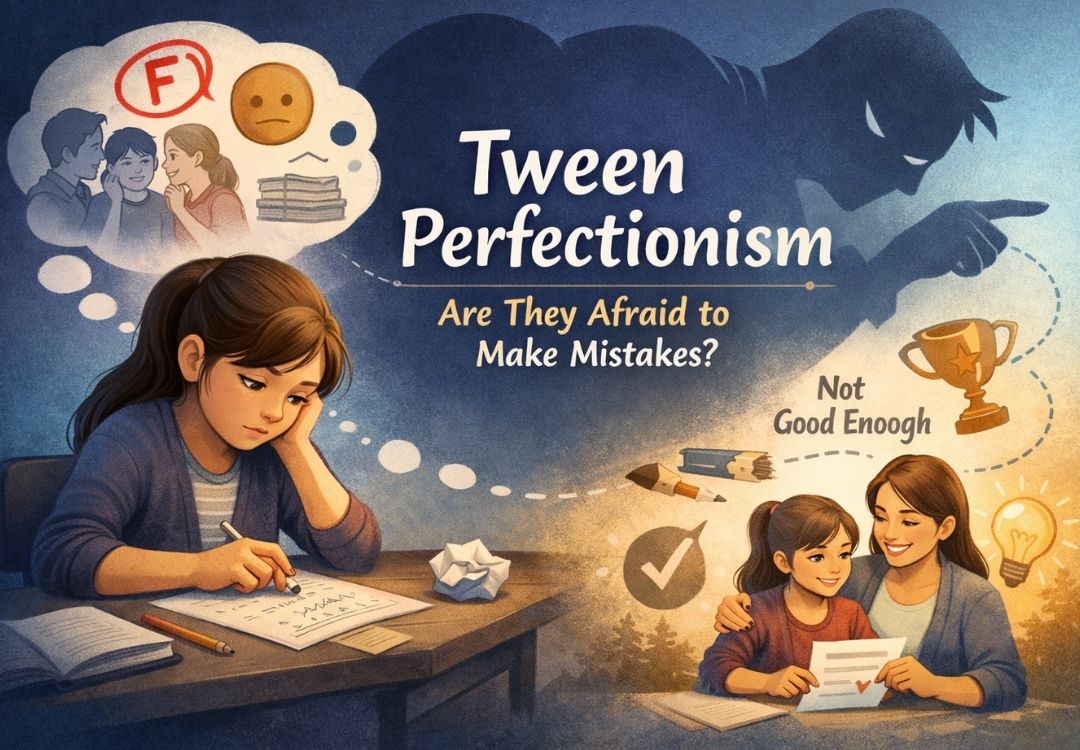
Some tweens don’t rush into things anymore. They pause. They hesitate. They double-check. Sometimes, they don’t start at all.
From the outside, it can look like high standards or strong discipline. But often, what’s underneath is fear. Not fear of failure itself, but fear of what a mistake might mean about them.
This blog looks at why perfectionism shows up during the tween years, how fear quietly fuels it, and how adults can help tweens feel safe enough to try, stumble, and learn.
Why Perfectionism Often Begins in the Tween Years
The tween years bring a shift in how children see themselves.
Between ages 9 and 12, tweens become more aware of expectations—at school, at home, and among peers. They start comparing themselves to others and noticing where they fall short. At the same time, their sense of identity is still forming.
Because of this, mistakes can start to feel personal. A wrong answer isn’t just wrong—it can feel like proof of not being good enough.
How Fear Sneaks Into High Standards
Perfectionism isn’t always about wanting to be the best. Often, it’s about wanting to avoid discomfort.
Tweens may fear:
- disappointing adults
- being judged by peers
- losing approval
- feeling embarrassed
So they raise the bar very high. If they can do something perfectly, they don’t have to face those feelings. Over time, avoiding mistakes becomes more important than learning.
What Perfectionism Looks Like in Daily Life
Perfectionism in tweens can be subtle.
Some tweens spend excessive time on homework, erase answers repeatedly, or get very upset over small errors. Others avoid trying new activities, quit quickly, or say “I can’t do it” before starting.
There are also tweens who appear highly capable but are constantly anxious, never satisfied with their effort, and deeply distressed by feedback.
Why Mistakes Feel So Heavy at This Age
Tweens are still developing perspectives.
They may struggle to see mistakes as temporary or useful. Instead, one error can feel like a lasting judgement. Because their self-image is fragile, mistakes threaten how they see themselves.
Without reassurance, the safest option can feel like not trying at all.
How Adults Sometimes Reinforce the Fear
Often without meaning to, adults can add pressure.
Praise that focuses only on results, frequent comparisons, or strong reactions to errors can send the message that mistakes are dangerous. Even well-meaning encouragement like “You can do better” can feel overwhelming to a perfectionistic tween.
What they hear is not motivation, but risk.
What Helps Tweens Feel Safer Making Mistakes
Tweens need repeated experiences where effort matters more than outcome.
When adults respond calmly to errors, normalise learning curves, and talk openly about their own mistakes, tweens begin to relax. They learn that mistakes don’t lead to rejection or disappointment.
Safety grows when trying is valued, even when the result isn’t perfect.
When Perfectionism Becomes Limiting
Some level of striving is normal. Extra attention may be needed when a tween:
- avoids tasks due to fear of failure
- becomes very anxious or distressed over small mistakes
- shows constant self-criticism
- loses joy in learning or play
- ties self-worth closely to performance
These signs suggest that fear may be driving behaviour more than curiosity.
How Support Can Make a Difference
Perfectionism doesn’t fade through pressure or reassurance alone.
Supportive conversations, emotional validation, and sometimes professional guidance can help tweens understand where their fear comes from and how to work with it. When a tween feels understood rather than pushed, confidence slowly replaces fear.
Conclusion
Perfectionism in tweens is rarely about ambition. More often, it’s about fear—fear of being wrong, of disappointing others, of not being enough.
When adults help tweens feel safe making mistakes, they make room for growth, resilience, and genuine confidence.
If you’re noticing perfectionism creating stress or avoidance in your child, SoulNirvana offers a supportive space through its Comprehensive Parenting Support Program and counselling services.
If it feels right, you can book a session now and explore how to help your child learn without fear.
About the Author:
I am a professionally qualified counsellor, psychotherapist (Rational Emotive Behaviour Therapy (REBT) - Albert Ellis, USA®, Transactional Analysis – Feeling Minds® and Lifestyle Prescriptions Health Coach, Germany®, established in private practice for more than 6 years. I also incorporate alternate techniques for supporting my client via Access Bars® & Metaphor Therapy. I am also working in the area of Cyber psychology and Emotional Intelligence.
FAQs
Q1. Is perfectionism common in tweens?
Yes. It often appears as social awareness and expectations increase.
Q2. Is perfectionism the same as motivation?
No. Motivation is driven by interest; perfectionism is often driven by fear.
Q3. Should parents push tweens to “relax”?
Gentle reassurance and emotional safety help more than pressure.
Q4. When should parents seek support?
When fear of mistakes limits learning, confidence, or emotional well-being.
References
Flett, G. L., & Hewitt, P. L. Perfectionism and child development.
https://psycnet.apa.org/record/2002-00960-000
UNICEF. Children, pressure, and emotional well-being.
https://www.unicef.org/parenting
Center on the Developing Child, Harvard University. Building resilience through safe relationships.
https://developingchild.harvard.edu