
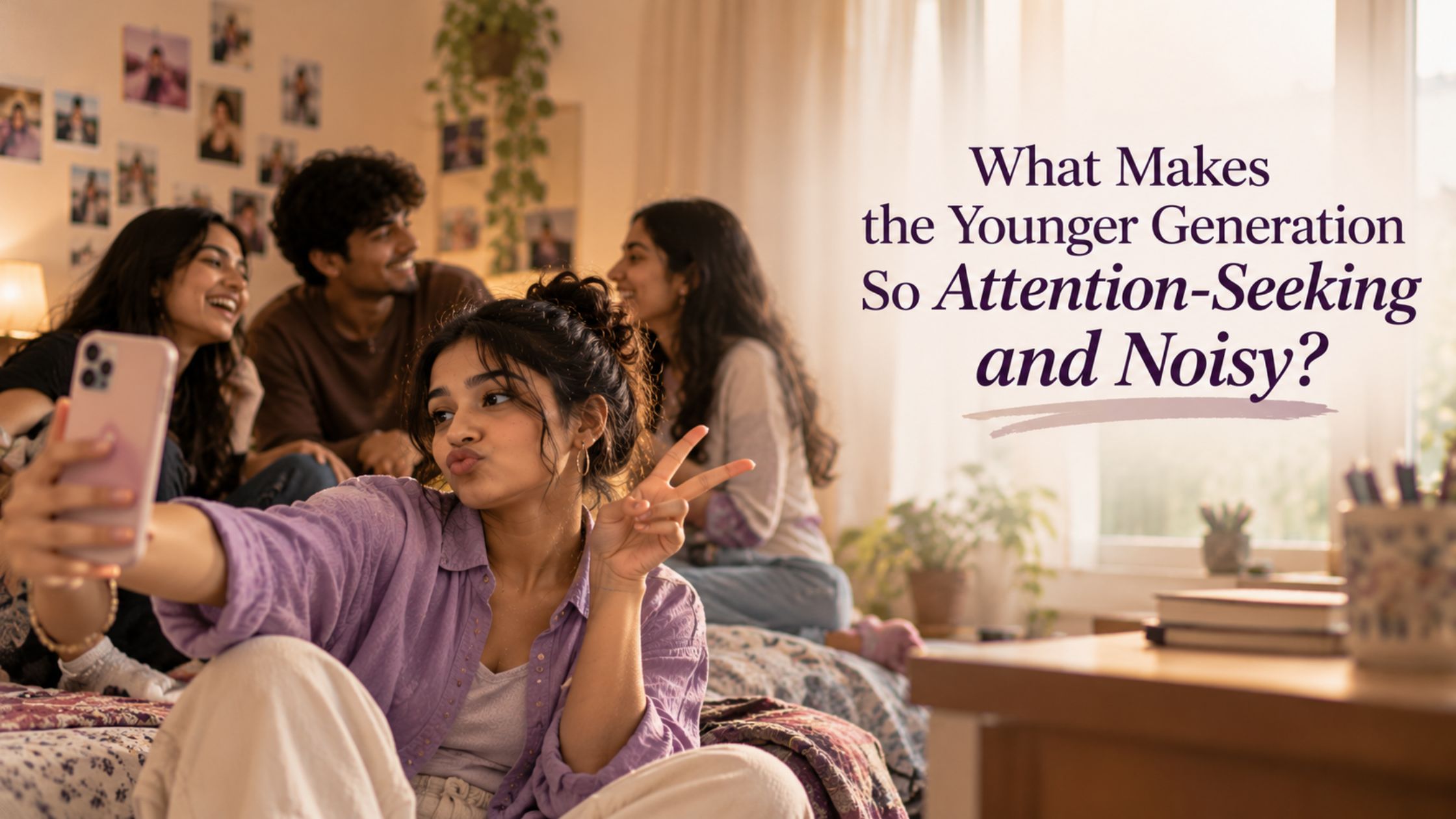
There was a time when being noticed was often a consequence of doing something meaningful. Today, being noticed can sometimes become the goal itself. A moment is recorded before it has been fully experienced, an opinion is expressed with the expectation of a reaction, and an ordinary experience can begin to feel incomplete if nobody else sees it. For some young people, being visible, heard, and acknowledged has become an important part of how they express themselves and understand their place among others.
This has led to a familiar observation: why does the younger generation sometimes appear so attention-seeking, expressive, loud, or eager to be noticed? The behaviour can be seen in social media posts, public conversations, online arguments, the desire to stand out, and the pressure to make personal experiences visible.
However, describing an entire generation as attention-seeking would overlook an important distinction. Young people have always wanted recognition, acceptance, and a sense of belonging. What has changed is the environment in which these needs are expressed. Social media, constant connectivity, peer comparison, and a culture that rewards visibility may influence how some young people seek attention and validation.
The more useful question is not simply why young people want attention, but what attention has come to mean in a world where being noticed can feel like proof of being important.
The Need to Be Seen and Acknowledged
The desire for attention is not inherently negative. People need connection, recognition, and a sense that their presence matters to others. For young people, these needs can be particularly significant as they develop their identities, form relationships, and become more aware of how others perceive them.
Being appreciated for an achievement, having an opinion taken seriously, or feeling included in a group can strengthen a person's sense of belonging. Wanting to express oneself is also a natural part of discovering who one is.
The difficulty begins when recognition becomes the main measure of personal worth. A young person may gradually begin to evaluate an experience not only by how it felt, but by how others responded to it. An achievement may feel less satisfying without praise, an opinion may seem less important without agreement, and a personal moment may appear less meaningful if it receives little attention.
When this happens, the need to be noticed can become difficult to satisfy. Recognition provides temporary reassurance, but the reassurance may fade quickly, creating a desire for another response.
This does not mean that every expressive young person is insecure or seeking validation. It means that the same outward behaviour can have different meanings, and understanding those meanings requires looking beyond appearances.
Growing Up in a World That Rewards Visibility

Social media has changed the way people present themselves and respond to one another. A person's thoughts, appearance, achievements, opinions, and daily experiences can be shared with an audience that may extend far beyond their immediate social circle.
These platforms can offer valuable opportunities for creativity, connection, self-expression, and finding people with similar experiences. However, they also make social feedback highly visible. Likes, comments, shares, and follower counts can turn responses from other people into numbers that are easy to compare.
The American Psychological Association has highlighted the importance of understanding how social media features and experiences interact with adolescent development, including young people's sensitivity to social feedback. Research also recognises that the effects of social media vary according to individual circumstances, the content encountered, and the way platforms are used.
Within this environment, being loud or noticeable can sometimes appear more rewarding than being thoughtful or understated. Content that provokes a strong reaction may attract attention, while quieter experiences may receive less visible feedback. Over time, some users may begin adjusting how they present themselves according to what attracts a response.
The result can be a subtle shift in motivation. Instead of asking whether something genuinely reflects who they are, a person may begin wondering whether it will attract attention.
The concern is not that young people share their lives online. It is that visibility can become so important that the experience itself begins to take second place to the reaction it might generate.
When Self-Expression Becomes a Performance
Young people are constantly learning how to present themselves to the world. They experiment with opinions, clothing, humour, interests, appearance, and different ways of communicating. This exploration can be an important part of developing an identity.
Yet, when self-expression takes place in an environment where an audience is always present, it can become difficult to separate personal expression from performance.
A person may begin expressing an opinion because they genuinely believe it, but also because they anticipate the reaction it will create. An ordinary experience may be exaggerated to make a story more interesting. A disagreement may become more dramatic because strong reactions attract attention. Even vulnerability can sometimes become something that feels as though it must be presented in a particular way to receive recognition.
This does not mean that every public expression is insincere. People can be authentic online, and sharing experiences can help them feel understood. The distinction lies in whether a person feels free to express themselves naturally or increasingly feels pressure to maintain an image.
When every experience seems to require an audience, private enjoyment can become harder to appreciate. A moment may be judged by how it appears rather than how it feels.
The ability to enjoy something without documenting it, explaining it, or seeking approval for it remains an important part of a balanced relationship with self-expression.
Why Quietness Can Feel Like Invisibility
In an environment where visibility is frequently rewarded, quietness may sometimes be mistaken for a lack of confidence, personality, or importance. People who speak less, share less, or prefer to remain outside the spotlight may receive less immediate recognition, even when they have meaningful thoughts and experiences.
For a young person who is still developing a sense of identity, this can create pressure to become more noticeable. Speaking louder, making stronger statements, following trends, or presenting a more dramatic version of oneself may seem like ways to avoid being overlooked.
The desire to stand out can become especially complicated when a person compares their everyday life with the carefully selected moments presented by others. Other people's achievements, celebrations, relationships, and experiences may appear constantly visible, while one's own ordinary life can seem unremarkable by comparison.
The problem is not that young people want to be distinctive. Individuality deserves room to develop. The problem arises when being different becomes another expectation to satisfy and when being ordinary begins to feel like a personal failure.
A person should not have to become louder to feel that they matter. Confidence can exist in a quiet voice, a thoughtful response, a private interest, or the ability to remain comfortable without constant recognition.
Attention-Seeking Can Sometimes Hide a Need for Connection
What appears to be attention-seeking behaviour does not always have the same underlying cause. Sometimes, it is simply enthusiasm, humour, confidence, or a desire to participate. At other times, it may reflect a wish for reassurance, acceptance, belonging, or connection.
A young person who repeatedly seeks reactions may be trying to understand whether they are valued by their peers. Someone who frequently shares personal experiences may enjoy communication and community. Another person may find it difficult to tolerate feeling overlooked because recognition has become closely connected to their sense of worth.
It would be inaccurate to assume that every loud or expressive person is emotionally insecure. Equally, dismissing every attempt to attract attention as immaturity can prevent us from noticing when someone is struggling.
The behaviour alone rarely tells the whole story. Its meaning depends on the individual, the circumstances, and the role it plays in their relationships.
This is why responding with ridicule or automatic criticism may not be particularly helpful. If a young person is seeking connection, making them feel ashamed of that need may not address what is happening underneath the behaviour.
Understanding does not mean approving of every action. It means recognising that behaviour can be examined with curiosity rather than judged immediately.
The Difference Between Confidence and the Need for Validation
Confidence and validation-seeking can sometimes look similar from the outside. Both may involve expressing opinions, sharing achievements, attracting attention, or standing out in a group. The difference becomes clearer when we consider how much a person's self-worth depends on other people's reactions.
A confident person can enjoy appreciation without needing everyone to agree. They can express an opinion while accepting that others may disagree, and they can experience disappointment without allowing it to define their entire sense of self.
When external validation becomes essential, the situation may feel different. A lack of response can be interpreted as rejection, criticism may feel like a personal attack, and disagreement may become difficult to tolerate. The person may repeatedly seek reassurance because the approval they receive does not create lasting confidence.
These patterns are not exclusive to younger generations. Adults can also become dependent on recognition, comparison, and approval. The digital environment simply creates additional opportunities for these patterns to appear and be reinforced.
Developing a more stable sense of self involves learning to value one's experiences, interests, relationships, and decisions without constantly measuring them against external reactions.
It also means understanding that being liked by everyone is neither possible nor necessary.
Are Young People Really Becoming More Attention-Seeking, or Are We Seeing Them Differently?
It is worth questioning the assumption that the younger generation is inherently noisier or more attention-seeking than previous generations. Every generation develops its own ways of expressing identity, seeking recognition, challenging expectations, and connecting with peers.
What differs today is the visibility of those behaviours. Conversations that once took place among friends may now appear on public platforms. Personal opinions can reach large audiences, and moments that would previously have remained private can become visible to strangers.
Digital platforms also make certain behaviours easier to observe, measure, and compare. This can create the impression that attention-seeking has become universal, even though young people differ considerably in their personalities, preferences, and online habits.
The evidence on social media and adolescent well-being is complex. The U.S. Surgeon General's advisory and the American Psychological Association both recognise potential benefits as well as risks, while noting that experiences differ across individuals and contexts. Social media can support connection and self-expression, but certain patterns of use and exposure may create challenges for some young people.
It is therefore more useful to examine the pressures shaping behaviour than to label an entire generation. Young people are growing up within a different communication environment, and understanding that environment is part of understanding their experiences.
Helping Young People Build an Identity Beyond Attention
Young people do not need to be taught that wanting recognition is wrong. They need opportunities to discover that recognition is only one part of a meaningful life.
Families and educators can help by creating spaces where young people are listened to without having to compete for attention. Genuine conversations, shared activities, personal interests, and relationships that are not based on online popularity can help make connections feel more substantial than a number on a screen.
It is also valuable to encourage reflection on the difference between sharing something because it feels meaningful and sharing it because silence feels uncomfortable. Young people can learn to notice how they feel before and after seeking online feedback, whether comparison affects their self-image, and whether their digital habits leave enough room for rest, concentration, and offline relationships.
The aim should not be to suppress individuality or discourage self-expression. It is to help young people express themselves without feeling that they must constantly perform for an audience.
Parents can contribute by listening rather than immediately criticising, asking thoughtful questions instead of making broad judgments, and modelling a healthy relationship with recognition themselves. Young people are more likely to engage in meaningful conversations when they feel respected rather than dismissed.
Above all, they need to know that their value does not depend on how loudly they speak, how many people notice them, or how often their lives receive public approval.
Conclusion: Being Seen Is Not the Same as Feeling Understood
The younger generation is often described as loud, expressive, or hungry for attention, but these descriptions can obscure the more complicated realities of growing up in a highly visible world. Some young people may be seeking recognition, some may be exploring their identities, and others may simply be expressing themselves in ways that differ from the expectations of older generations.
The important distinction is between wanting to be seen and feeling that one must constantly be seen to matter.
When attention becomes the primary measure of worth, it can be difficult to feel satisfied without another response, another achievement, or another opportunity to stand out. But meaningful confidence develops through more than visibility. It grows through self-understanding, genuine relationships, personal interests, and the ability to remain comfortable without constant approval.
At SoulNirvana, psychological support can provide a space for young people and families to explore questions around identity, self-esteem, social comparison, and the need for validation, while developing healthier ways of understanding themselves and relating to others.
Perhaps the goal is not to make the younger generation quieter. It is to create a world in which young people feel secure enough to express themselves when they have something to say, comfortable enough to be quiet when they do not, and confident enough to know that their worth remains intact either way.
FAQs
Why do some young people seek so much attention?
The reasons vary. Some may enjoy expressing themselves, while others may be looking for belonging, recognition, reassurance, or social acceptance. Behaviour should be understood in its individual context rather than attributed to an entire generation.
Does social media encourage attention-seeking behaviour?
Social media can reward visible reactions through likes, comments, and shares, which may influence how some people present themselves. However, its effects vary, and online platforms can also support creativity, connection, and self-expression.
What is the difference between self-expression and validation-seeking?
Self-expression involves communicating thoughts, feelings, or identity, while validation-seeking becomes a concern when a person's sense of worth depends heavily on external approval. The two can overlap, but they are not the same.
How can parents help young people develop confidence?
Parents can listen without immediately judging, encourage interests beyond social media, discuss comparison and online feedback, and help young people recognise their strengths without relying entirely on external approval.
Is being loud or expressive a sign of insecurity?
No. A loud or expressive personality does not automatically indicate insecurity or a need for validation. The meaning depends on the person's behaviour, circumstances, and emotional experience.
References
- American Psychological Association. Health Advisory on Social Media Use in Adolescence. https://www.apa.org/topics/social-media-internet/health-advisory-adolescent-social-media-use
- U.S. Surgeon General. Social Media and Youth Mental Health. https://www.hhs.gov/surgeongeneral/reports-and-publications/youth-mental-health/social-media/index.html
- National Academies of Sciences, Engineering, and Medicine. Social Media and Adolescent Health. https://nap.nationalacademies.org/catalog/27396/social-media-and-adolescent-health