
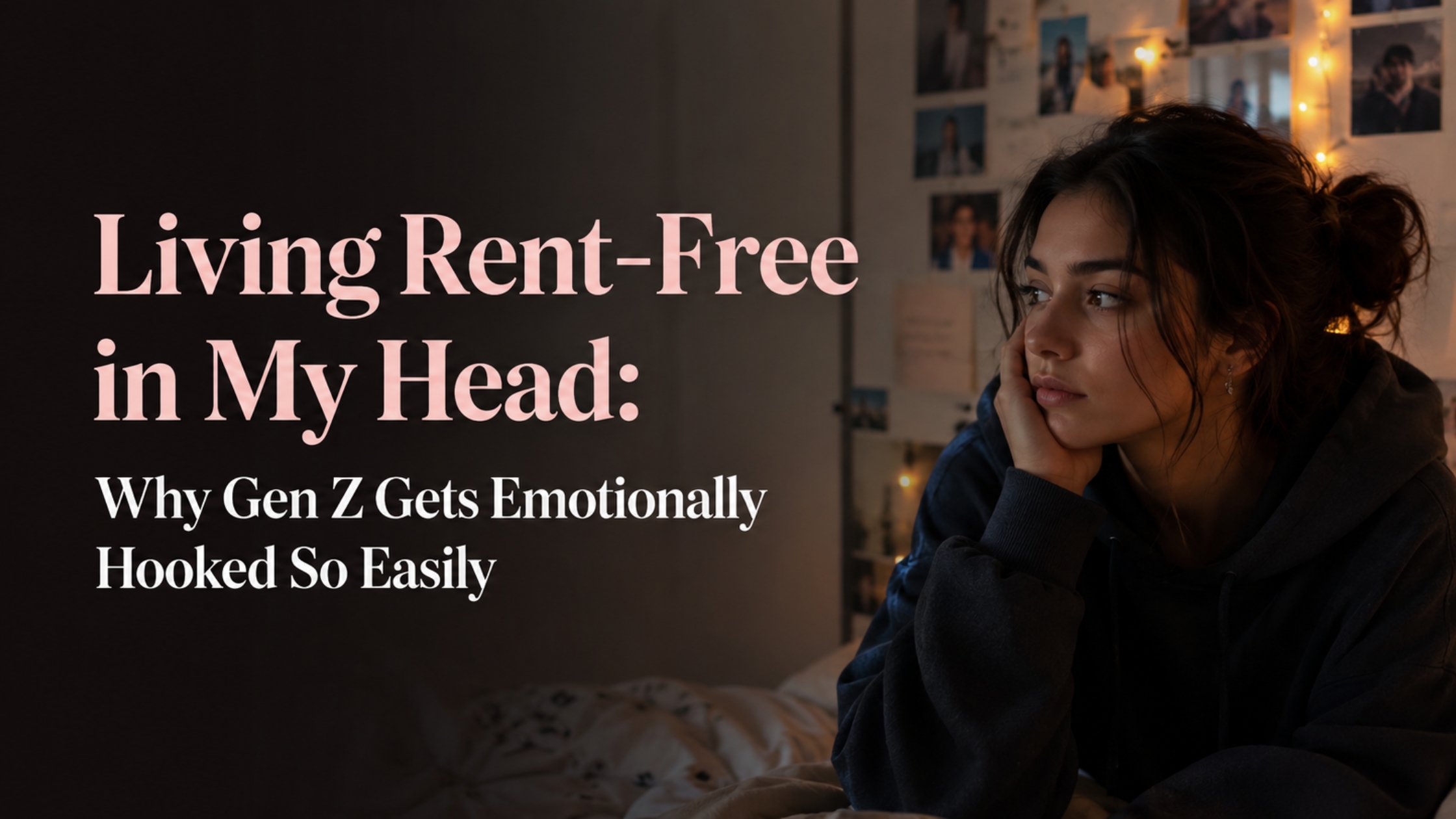
Sometimes it’s not even a full relationship. It could be someone you barely dated, someone who gave mixed signals, someone who left suddenly, or someone you never fully got closure from. And yet, somehow, they stay in your mind constantly.
You replay conversations. You revisit memories. You imagine future scenarios that may never happen. Even when life moves on externally, mentally the person still feels present.
For many Gen Z individuals, this emotional looping has become surprisingly common. This blog explores why some people stay “rent-free” in the mind, why emotional attachment feels so intense today, and what makes it hard to let go.
Why Some People Stay in Our Minds Longer Than Others
Not every connection affects us equally.
Some people touch emotional needs, insecurities, hopes, or fantasies in ways that feel deeper than the actual time spent together. The mind holds onto experiences that feel emotionally unfinished.
This is why someone from a short connection can sometimes occupy more mental space than a long relationship.
The brain often struggles more with uncertainty than with endings.
The Role of Overthinking

Gen Z tends to process relationships mentally almost as much as emotionally.
Conversations get analysed repeatedly:
- What did they really mean?
- Why did they suddenly change?
- Did I do something wrong?
The mind keeps searching for answers, patterns, or certainty. Instead of naturally fading, the connection becomes mentally active through constant replaying.
Overthinking keeps emotional attachment alive.
Why Mixed Signals Feel So Addictive
One of the strongest triggers for emotional obsession is inconsistency.
When someone is warm one moment and distant the next, the emotional system becomes hyper-focused. The unpredictability creates emotional tension, and the brain starts seeking resolution.
This push–pull dynamic often feels more intense than stable connection because uncertainty creates emotional fixation.
The mind stays attached to the possibility of clarity.
How Social Media Makes Letting Go Harder
Earlier generations had distance after endings. Gen Z often has visibility.
You can still see updates, photos, stories, playlists, and online activity long after emotional connection fades. Even without direct interaction, the person remains psychologically present.
This makes emotional detachment harder because the brain never fully experiences absence.
Instead of closure, there is continuous low-level exposure.
The Difference Between Missing Someone and Being Emotionally Hooked
Missing someone is natural.
Being emotionally hooked feels different. The person starts occupying mental space beyond the actual relationship. Your mood, thoughts, and attention repeatedly circle back to them.
Sometimes the attachment is less about the person themselves and more about:
- what they represented
- what you hoped for
- how they made you feel about yourself
This is why letting go can feel emotionally bigger than the relationship looked externally.
Why Gen Z Feels This So Deeply
Gen Z relationships often move emotionally fast.
People share vulnerabilities early, communicate constantly, and form emotional intimacy through messaging and digital presence. This creates quick emotional closeness—even before real-world stability exists.
At the same time, many people are already struggling with loneliness, insecurity, or identity confusion. Relationships then become emotionally amplified because they feel tied to belonging and self-worth.
The Fantasy Loop
Sometimes attachment is sustained by imagination more than reality.
The mind keeps replaying:
- what could have happened
- what should have happened
- what might still happen
This fantasy loop creates emotional continuity even when the relationship itself has ended or never fully existed in a stable form.
The emotional attachment becomes partly internal.
Why Closure Doesn’t Always Fix It
People often believe closure will stop the attachment.
But emotional loops are not always solved through explanation. Sometimes the mind keeps searching because the emotional need underneath—validation, reassurance, connection, certainty—still feels unresolved.
The person becomes symbolic of something deeper.
What Helps Break the Loop
Letting go is rarely instant.
It begins with gently reducing emotional feeding of the loop:
- less constant checking
- less replaying conversations
- less romanticising uncertainty
It also helps to reconnect with parts of life and identity outside the attachment. Emotional space slowly returns when the mind is no longer organised around one person.
Healing often comes through grounding, not through more analysis.
The Bigger Picture
Gen Z is growing up in a world where emotional access is constant but emotional clarity is often missing.
People are more connected digitally, yet many relationships remain uncertain, undefined, or emotionally inconsistent. This creates the perfect environment for attachment loops and overthinking.
The issue is not weakness. It’s emotional overstimulation combined with uncertainty.
Conclusion
When someone lives “rent-free” in your mind, it’s rarely just about the person.
It’s often about unfinished emotions, unmet needs, uncertainty, and the meaning attached to the connection. Understanding this can help reduce self-blame and create space for healthier emotional boundaries.
If you’ve been feeling emotionally stuck on someone or trapped in constant relationship overthinking, SoulNirvana offers a supportive space through its Psychological Counselling services. If it feels right, you can book a session now and begin understanding the emotional patterns keeping you stuck.
FAQs
Q1. Why do I keep thinking about someone even after the relationship ended?
Because emotional attachment and unresolved feelings can continue mentally long after physical connection ends.
Q2. Why are mixed signals so hard to move on from?
Uncertainty keeps the brain emotionally engaged and searching for clarity.
Q3. Is overthinking making the attachment stronger?
Yes. Constant mental replaying often keeps emotional loops active.
Q4. Can emotional attachment become unhealthy?
It can when it begins affecting emotional well-being, focus, or self-worth.
References
American Psychological Association. Attachment, rumination, and relationships.
Helen Fisher. The brain in love and attachment.
National Institute of Mental Health. Emotional regulation and thought patterns.
Pew Research Center. Social media and emotional behaviour among young adults.